“Eliyahu's Branches: The Descendants of the Vilna Gaon and His Family”
Review by Arthur Kurzweil
Published in Avotaynu.
Eliyahu's Branches: The Descendants of the Vilna Gaon and
His Family by Chaim Freedman. Avotaynu, 1997. 704 pp.
It is not since Neil Rosenstein's extraordinary ground-breaking work, The Unbroken Chain, that I have had such enjoyment reading a book in our field of Jewish genealogy. “Eliyahu's Branches: The Descendants of the Vilna Gaon and His Family” by Chaim Freedman, which traces the family tree of Rabbi Elijah, the Gaon of Vilna, is as fascinating as a detective novel, intricate as a scientific thesis, and uplifting as the most beautiful poetry.
A great sage once said that the Jewish People, as a single entity, is not an animal but a plant. The implications of this metaphor are frightening, or at best paradoxical, for as every botanist knows, it is when a plant is cut back that it is stimulated to grow. I have heard a stirring presentation on this notion from a revered rabbi who aptly points out that when we look at Jewish history, the pattern becomes clear. A few examples will suffice: right after the incredibly traumatic expulsion from Spain, we see the most creative period in Jewish theological history, that of the mystics of Safed; after the massacres in the Ukraine, we see the great revival movement known as Hasidism; after the Holocaust, we see the birth and growth of the State of Israel.
This troubling metaphor passes through my mind as I reflect on Eliyahu's Branches. It does not take much imagination to actually feel that it is not a book, but a living, growing part of that glorious tree called the Jewish People. As I leaf through this inspiring book, I feel like I am looking at one of those scientific documentary films that use special photography to show us how flowers grow and bloom. The petals appear and unfold right before our eyes.
We, in Jewish genealogy, often quote a well-known passage found in the Talmud: If you save one life, you save a whole world; if you kill one life, you kill a whole world. Of course, every family tree, from the most modest to the most elaborate, illustrates this notion: How many of us have been struck by the realization that if a certain two people never met, married and had children, we-and dozens, if not hundreds of others would not be here? This is the striking message of this outstanding, deeply moving new book; every life is sacred; every life has the potential to create an entire world.
Chaim Freedman has been researching the descendants of the illustrious Gaon of Vilna for more than 30 years. And, while the careful critic will observe that Freedman makes some leaps of faith in this methodology, resulting in some doubtful branches and descendants, one must surely be in awe of his monumental efforts. The introductory material in this book, where the author explains some of his methods and some of the many difficulties involved in such a mammoth search, will delight any family historian. Freedman invites us to think about his search strategies and some of the stumbling blocks that he had to encounter. Of great importance is Freedman's discussion about the pitfalls and problems facing the genealogist who must depend upon sometimes dubious oral testimony. (In all of my travels, including public speaking about Jewish genealogy before more than 800 Jewish groups nationwide, the one individual who is claimed as an ancestor more than any other is the Vilna Gaon.)
The vast majority of this book is the genealogy itself. Freedman has painstakingly tracked down about 20,000 descendants of the Vilna Gaon, providing the reader with capsule biographies of many of them. These brief biographies alone communicate the exceptional creativity bursting forth from the lives of the descendants of this illustrious sage. But, this massive volume offers more: There is a wonderful essay on the importance of genealogy as reflected in Jewish thought through the ages; biographical material on the Vilna Gaon himself; a listing of every town mentioned in the book (along with the current name of the location); a useful glossary; a rich bibliography of sources; and, of course, a name index.
Every Jewish genealogist should have this book on his or her shelf. Even if the contents do not help you specifically with your research, the volume will serve as an inspiration, not only to show what can be done in our field if one has the will, but, also, as a monument to an eternal people, who despite the trials and tragedies of history, persevere.


The Gaon of Vilna - Verifying Oral Tradition
THE GAON OF VILNA - VERIFYING ORAL TRADITIONS
Based on "Eliyahu's Branches - The Descendants of the Vilna Gaon and His Family",
Chaim Freedman "Avotaynu 1997.
Based on "Eliyahu's Branches - The Descendants of the Vilna Gaon and His Family",
Chaim Freedman "Avotaynu 1997.
Published as an article in Avotaynu, Volume XIII, #3, Autumn, 1997
Chaim Freedman – lecture to the Israel Genealogy Society, Jerusalem, February 2000.
The Legend
Tracing the family tree of the Gaon of Vilna, has long posed a challenge to genealogists due to the many difficulties encountered in validating the claims of families which hold an oral tradition of descent from the Gaon. Many families of Lithuanian origin preserve a tradition of descent from the Gaon, but the exact nature of many of their claims defies clear definition. Indeed, the apparent uncertainty of such claims has engendered amongst scholars and the general public an attitude of scepticism as to their authenticity, and an aura of legend has surrounded this perplexing puzzle.
THE HISTORY OF RESEARCH OF THE FAMILY OF THE GAON OF VILNA
A number of attempts have been made in the past to research the family of the Gaon of Vilna. The most comprehensive published genealogy is "Sefer Hayakhas Lemishpakhat Rivlin Umishpakhat HaGaon miVilna " (the Genealogy of the Rivlin Family and the Family of the Gaon of Vilna) written by the late Eliezer Rivlin in Jerusalem in 1935. He recorded many branches of the Gaon's family that were known at the time. But Rivlin's work encompasses only 300 descendants of the Gaon . It should be noted that at the time when Rivlin conducted his research (prior to the Second World War) communication technology was limited, and the difficulty of exchange of information over closed borders limited the scope of the material Rivlin was able to collect.
Number of descendants
A mathematical extrapolation over the eight to ten generations that are descended from the Gaon can be shown to yield about 140,000 - 150,000 theoretical descendants. Even allowing for factors such as cousin marriages and considerable decimation during the Holocaust, the Gaon's family tree should potentially encompass a considerable number of families of Lithuanian origin.
Personal involvement
This author has been interested in the genealogy of the Gaon since his childhood when he heard his grandparents telling stories about their ancestors, including the Gaon of Vilna. The subject of the Gaon gained new momentum during a discussion which took place in Jerusalem between genealogist the late Rabbi Shmuel Gorr and Benyamin Rivlin, son of Eliezer Rivlin, the author of the above-mentioned original genealogy of the Gaon. Rivlin suggested to Gorr that he propose to Chaim Freedman that Freedman take upon himself the project of updating the Gaon's genealogy. This major research project was instigated in mid-1987. Its objective was to collate all available material about the Gaon's family and to publish an updated genealogy. The importance of pursuing this project was that it would provide the last opportunity to preserve oral traditions and link them to related archival material before the passage of time further eroded the genealogical memory base of oral traditions which were the key to research.
Comparison of parallel traditions
Cross-reference by the author of seemingly independent family histories resulted in the discovery of long-standing missing links. Families which held traditions that, when considered individually failed to provide a basis for establishing their descent from the Gaon, yet when collated by the author, displayed a common denominator which led to the establishment of their relationship.
Collection of material
Freedman's research involved the recording, analyzing and assessing of material provided by families claiming a relationship with the Gaon, as well as a comprehensive survey of library resources in Israel including community histories, newspapers, journals, rabbinic texts, biographies, manuscripts and published family histories.
Additional material was provided from resource centres outside Israel by Freedman's genealogical colleagues. Notable New York genealogist, Alex Friedlander was of particular and constant help. He researched vital statistic records obtained from Polish and Lithuanian archives.
The material collected by Freedman constitutes a valuable database for those interested in the Gaon's family.
FAMILY CATEGORIES
The nature of the material researched by this author in preparing a book on the family of the Gaon of Vilna necessitated the establishment by the author of three categories of families:
1) Families which claim a relationship with the Gaon of Vilna that is definitely established by reliable sources and records.
2) Families which hold an oral tradition of a relationship with the Gaon that, when critically analysed in the light of sources and records, is, in the opinion of the author, highly likely to be valid, beyond any reasonable doubt.
3) Families which hold an oral tradition of a relationship with the Gaon, but are unable to provide sufficient evidence for the author to verify their claims from the sources available to him. Such families have been further divided into two groups:
a) Families for which sufficient evidence exists for the author to decide to record the available information, for the purpose of preserving it in case further evidence is discovered in the future. Should such evidence be discovered, the inclusion of these families will facilitate a renewal of research, which may lead to the authentification of the families' relationship with the Gaon.
b)Families which have provided information that, after analysis and research by the author, enabled him to come to the conclusion that, in his opinion, these families are most probably not related to the Gaon.
ORAL TRADITION AND DOCUMENTED SOURCES
Modern aids
The place of oral tradition in genealogical research is the subject of academic dispute. Modern genealogist have at their disposal many sources which were unavailable to their predecesors several decades ago. Modern computer and communication technology facilitate access to a wide range of depositories of sources. Documents preserved by archives throughout the world are becoming more readily accessible, particularly those documents which are held in libraries and archives in the former Soviet Union and neighbouring countries.
Past reliance on oral family history
Genealogists in the past have relied mainly on records kept by family members. These were supplemented by research in libraries and archives where communal and personal documentation may have been found. In the case of families of rabbinic descent, the religious literature provided considerable information about the familial relationships of the authors.
Vital Statistic records versus oral tradition
Given the rapid advances in modern Jewish genealogical research, much of it based on newly uncovered vital statistic records (birth, marriage and death registrations), there is a tendency amongst researchers to play down the importance and validity of oral tradition.This author contends that oral tradition still has, and always will have a valuable place in Jewish genealogical research. A person usually is told by his parents, grandparents or other relatives about his family history.This is the first indication that a person receives about his family history and is derived from oral tradition. Documents may or may not be available to support this information, but in their absence it is the natural tendency of a person to initially accept what he has been told. If he is sufficiently interested, he may engage in research in order to validate the oral traditions and to expand the information which he may desire to preserve for the benefit of future generations.
Limitations of Oral History
It cannot be denied that the indiscriminate use of oral tradition by genealogists has its pitfalls. It may be embellished in order to aggrandise past generations. Distasteful information may be suppressed. When oral information is repeated it may not be recalled accurately, or it may be distorted due to insufficient attention paid when the information was conveyed. These distortions and inaccuracies may be perpetuated when the information is passed on to subsequent generations. In extreme cases information may even have been fabricated.
In assessing the validity of oral tradition it is important to analyse the terms in which it was conveyed. In particular it is important to know whether the information was conveyed spontaneously without any leading questions which may have put into the mind of the person being questioned ideas which were not part of the original information. However, with respect to certain factors, it is valid to ask leading questions. For instance, a parent or grandparent may not recall the name of an ancestor when asked for the name directly. Yet, if the question is rephrased in terms of after whom the parent was named, he may then recall that he was told that he was named after a certain greatgrandparent. Such oral information may then lead to a new line of research.
Preservation of traditions for future research
The greater the number of generations removed from a particular ancestor being sought, the more likelihood there is of discrepancy in oral tradition. If one is told that one's grandfather claimed that his grandfather was a fourth generation descendant of the Gaon then there are thirty-two possible lines of descent from the Gaon. There may be additional information, such as place of residence or dates of birth which may reduce the possibilities. But the number of ancestral lines which need to be researched is still very large. If the link is not discovered in the current generation and the story is passed on to yet another generation, members of that generation have to cope with a bigger puzzle in which the number of possibilities soars to sixty-four. This simple calculation further justifies the author's decision to record all reasonable oral traditions in his book on the family of the Gaon of Vilna, in order to assist the coming generations should they try to uncover the `missing link'.
Oral tradition and documented sources complement each other in pursuing lines of research.A competent genealogist takes into account all the above factors in considering the validity of oral tradition, uses the available documented sources, and comes to a conclusion which is valid beyond a reasonable doubt.
Attitude to oral tradition in Judaism
Since this book deals with one of the most prominent personalities of Jewish scholarship, it is fitting that a principle established in traditional Jewish law be used to support the case for the use of oral tradition. Jewish law defines the forms of evidence required in solving a dispute brought before a Beth Din. Considerable material exists in the Talmud and in its commentaries about the need for conclusive evidence being presented to prove cases brought to litigation.
The late Rabbi Shmuel Gorr of Jerusalem, a prominent genealogist, used to expound the Talmudic principle ( (זבחים פרק י"ד, משנה ד'that the assertion: "I have not seen it", that is no evidence (to the contrary). He explained that simply because documented evidence may not have been discovered does not mean that the evidence does not exist, or that the point claimed to be valid must be disregarded. This was one of Rabbi Gorr's favourite quotations whenever the value of oral tradition was denigrated.
In his book on the family of the Gaon of Vilna the author exhaustively sought documented evidence to establish the genealogy of the families included. Oral tradition has been objectively considered. In many cases the author has consulted genealogical colleagues and taken into consideration their opinions.The conclusions presented are those of the author based on his expertise and experience in Jewish genealogical research.
RESEARCH DIFFICULTIES
The paradox - only 200 years
The difficulties that have been encountered over the years in tracing the descendants of the Gaon are surprising, considering that only 200 years have elapsed since his death in 1797. Only about eight generations have been born since that time . At the time Freedman started his research in the early 1960's, there were people alive who had heard stories about their descent from the Gaon from their grandparents (born in the 1830's) who were grandchildren of the Gaon's grandchildren (born in the 1780's). Such a chain of oral tradition was not so extended as to preclude the preservation of far more oral traditions than were in fact discovered.
There are several reasons for the difficulties encountered in researching the Gaon's family.
1) Lack of official records
Official records of births marriages and deaths were kept by a law instituted in the Russian Empire only in the early 19th century, except for communal lists which were compiled several times during the 18th century. Since all of the Gaon's children and most of his grandchildren were born prior to this date, there were few official records which could confirm their identity. It was not until the commemorative activities which took place in Vilna in 1997 to mark the 200th anniversary of the Gaon’s death that the census of 1765 was revealed. Study of the family unit of the Gaon made it possible to confirm the relative age of the Gaon’s sons as proposed in my book. Later the census lists for 1784 and 1795 added to the overall picture.
2) בטול תורה
It is a characteristic of Lithuanian families to play down their Yichus (pedigree). One example of this phenomenon was encountered when Freedman contacted an elderly rabbi living in Jerusalem. He was reluctant to discuss the issue, but grudgingly related what his mother had heard from her mother about their descent from the Gaon. But he soon cut the conversation short retorting: "What does it matter. Such research is Bitul Torah". He was expressing the sentiment of which the Gaon himself was a renowned proponent. One is obligated to spend as much time as possible in the study of the religious texts. The only time which can be justifiably used for other purposes is that needed to earn a mimimal livelhood. Even time required to attend to family affairs is begrudged. There are several stories related about the Gaon's disinterest in his children's everyday activities, despite his love for them. In the light of this attitude it is no wonder that orthodox Lithuanian families spent little time telling their children about their family history. Thus, much information was forgotten with the passage of time.
One oral tradition conveyed to this author related that an elderly relative in Vilna had possessed a book in which the Gaon himself had recorded his genealogy. Bearing in mind the Gaon's personality and relationship with his family, this story was obviously fictitious, or at best, an embellishment of some other book in the family's possession.
3) Wars
Wars and pogroms which plagued Europe over the last 200 years destroyed many records. Jewish cemeteries have been severely damaged or obliterated in many towns in which the Jewish population was decimated by the Holocaust. The loss of six million Jews during the Holocaust severed what might have been a continuation of the passage of oral traditions.
4) Migration
Mass emigration of Jews from the age old cradles of their family origins in Europe to the `New World' in North and South America, England, Australia, South Africa and Israel severed the natural contact between the generations. A new generation grew up, cut off from contact with its grandparents. Immigrant parents were all too anxious to forget about the Diaspora and its often sad and harsh history. It is no wonder that genealogical information was not passed on.
Information useful to genealogists is often found in old Hebrew prayer books, bibles or other religious texts. It was the custom in traditional families to record names of relatives and their dates of death in such books and pass them on to the ensuing generations. When young couples emigrated, these books usually remained with their parents, since they were still in use. Only if the parents or grandparents had already died at the time of their family's emigration might such books be taken with the emigrants, if they valued them.
Photographs are also useful in establishing genealogical details. But people often are negligent in not writing the names of the subject of the photograph on the back. When these photographs are passed on to the next generation, the identity of the relatives depicted is often unknown.
Sometimes, such photographs can lead to completely erroneous conclusions. This author was presented with an album of photographs collected by an elderly relative. Some were inscribed on the back, and others were identified by elderly relatives still alive. One photograph was the subject of much conjecture until the author examined the Russian inscription. It was a photograph of the famous Russian writer, Leo Tolstoy, obviously not a relative at all !
5) Modesty
Because the Gaon of Vilna was such a prominent figure in Jewish scholarship, descent from him was considered to be particularly worthy of honour. Some people may have been embarrassed to publicise stories told by their parents about their descent lest they be thought to be boasting. Descent from the Gaon also carried with it a responsibility to live up to his standards of behaviour, particularly in religious matters. Perhaps people who no longer were religiously observant considered descent from the Gaon an onerous burden.Yet, ironically, many non-observant people take great pride in their descent from the Gaon and preserve the oral traditions conveyed to them.
6) The title “Gaon"
The term `Gaon' was quite sparingly used during the time of the Gaon of Vilna. Over the ensuing generations it has been rather liberally ascribed to rabbinic scholars as a term of honour. This may result in a person being told that he was descended from `the Gaon' yet the term may refer to another rabbi who was known by that title.
The families Elion and Jodaikin held a tradition of descent from the "Gaon Eliyahu" and believed therefore that their ancestor was the Gaon of Vilna. Two factors led to the confusion. The families were in fact descended from a famous rabbi who was often referred to as a "Gaon". He was Rabbi Eliyahu Luntz (or Rabbinowitz) of Krozhe. Furthermore, this Eliyahu was a brother-in-law of the Gaon of Vilna whose second wife was Luntz's sister. The coicidence of these two factors led the above families to believe that they were descended from Eliyahu, the Gaon of Vilna.
An extreme example of confusion between rabbinic personalities arose when the author was informed by a certain family of it's descent from the Gaon of Vilna. Unable to discover the link, the author's problem was solved when his contact apologised profusely. The ancestor was actually Rabbi Shneour Zalmen of Liadi, ironically the Gaon's rival !
7) Forgotten daughters
Genealogies of rabbinic families often omitted sons or sons-in-law who were not scholars. Similarly, daughters were often not recorded in such families. The Gaon's son Rabbi Yehudah Leib of Serhei, Lithuania is recorded in Rivlin's work as the father of only two daughters. This author has discovered that Yehudah Leib had at least six daughters.
8) עין הרע
Certain families, known to be descended from the Gaon, simply refuse to publish their family tree, for a number of personal reasons. This is regrettable, since their non-inclusion in this present book may lead to the impression, in the future, that such people are really not descended from the Gaon. A prominent rabbinic family in Israel is known to have about 500 living descendants, yet the family refuses to record their names.
9) Surname changes
Siblings born to a mutual father often used different surnames to each other and to that borne by their parents. This practice was prevalent in the Tsarist Empire, and was a ploy used to confuse the military authorities. The notoriously anti-Semitic practices of the Tsarist army resulted in male Jews using this surname change as a means of evading conscription. Such variation of surnames within the one family leads to confusion in genealogical research.
For example, one of the Gaon's daughters, Khiena, the wife of Rabbi Moshe of Pinsk, bore eight sons who used the surname Chinitz, one whose surname is unclear, but whose descendants used the name Lipshitz and Neches. Certain families claim that one of Khiena's sons used the surname Penchuk and yet another, Landau.
Each of these claims had to be carefully analysed by the author, and some remain unverified.
10) Inaccurate translations
Some historians and genealogists who are not fluent in Hebrew have used, as the basis of their research, sources translated from Hebrew to English. These second-hand sources are prone to errors. Similarly, members of families which claim descent from the Gaon of Vilna, have been assisted in their research by incompetent translators, who are not familiar with the genealogical nuances of sources.
One researcher went to the trouble of having Rivlin's work translated into English. This led to confusion between a descendant of the Gaon's brother who lived in the town of Eiragola, Lithuania, or Ragoler to the Jews, with a certain person who live in a place called Raguva. The researcher conveniently merged the two personalities and added to his family tree hundreds of people who had no place on it.
THE WIVES, SIBLINGS AND STUDENTS OF THE GAON OF VILNA
Wives
The Gaon was married twice. The first wife was Khana, daughter of Yehudah Leib of Keidan. After Khana's death in 1782, the Gaon remarried a widow Gittel, daughter of Rabbi Meir Luntz (born 1709) of Krozhe, Lithuania. The fact that the Gaon was married twice has caused considerable confusion. There are families that held a tradition of descent from the Gaon's second wife, Gittel. Since the sources on her family clearly establish that Gittel bore no children to the Gaon, then families descended from Gittel are descended from her first husband, and not from the Gaon.
A major error made by a certain researcher arose from the Gaon's second marriage. Knowing that the Gaon was a brother-in-law to Rabbi Yekhezkel Luntz of Shavli, the researcher assumed that the connection was through Luntz's wife Malka. The researcher drew up a family tree of the Gaon's family and included all of the descendants of Yekhezkel Luntz as descendants of the Gaon's hypothetical sister, Malka. If the researcher had been conversant with Hebrew sources, he would have been able to read a book written by a grandson of Luntz, the contents of which make it clear that there was no such descent. The Gaon was a brother-in-law of Luntz, not through a hypothetical sister, but due to the fact that Luntz's sister Gittel was the Gaon's second wife.
Brothers and relatives
Certain families have believed that they were descended from the Gaon. After investigation however, it becomes clear that they were descended either from the brothers of the Gaon, or from one of his students. Terminology used to refer to relationships is misleading. "Of the family of the Gaon of Vilna" may mean actual descent, but more often the term refers to the descendants of the Gaon's siblings, or even may refer to more further removed connections by marriage without an actual blood relationship.
A prominent family that settled in Jerusalem 140 years ago maintained steadfastly it was descended from a daughter of the Gaon. This author failed to identify the relevant daughter, despite considerable research by members of the family. Recently new material came to light. A letter written about 1855 by a Lithuanian rabbi records a match arranged between his son and a daughter of the above family in Jerusalem. Of immense genealogical value was a statement by the writer of the letter giving details of the descent of the bridegroom from a sister of the Gaon. At last the puzzle had been solved.
Erroneous families
One of the Gaon's ancestors, Rabbi Moshe Kremer, who was chief rabbi of Vilna in the seventeenth century, was known as "Kremer", meaning shopkeeper, since his wife operated a stall in the market. The appelation "Kremer" was not a surname. Indeed most Jews in the Russian Empire only acquired surnames at the beginning of the nineteeth century. Yet many families bearing the name Kramer or Kremer erroneously believe that they are descended from the Gaon of Vilna. (Some are descended from a brother of the Gaon whose descendants did adopt the name Kremer).
Likewise a widely ramified Galician family believe that they are descended from the Gaon, simply because they bear the surname Wilner.
DOUBTFUL ORAL TRADITIONS
An important means of disproving certain oral traditions is often a simple arithmetic calculation.
Members of a certain Kossowsky family, whilst probably genuinely descended from the Gaon, instilled doubt in the mind of the author when they claimed that an ancestor recalled sitting on the knee of the Gaon, who, it was claimed, was her grandfather. Since the Gaon died in 1797, and since the ancestor was born in 1826, this incident could not possibly have occurred. On rechecking the source of the story, it was found that the incident occurred a generation earlier, which brought the event within a feasible time frame.
The Kantorovitch family of Jerusalem, whose claims to descent from the Gaon are most likely valid for other reasons, recorded certain events which cannot have occured in the way they were stated. It was claimed that the Gaon's youngest son Avraham wrote a letter to a grandson, Yaakov Koppel Kantorovitch, congratulating Kantorovitch on the completion of his studies and on obtaining Semikha (rabbinic ordination). Since Avraham died in 1808 at the age of 44, it is not likely that he had grandson of a suitable age to have obtained Semikha during his lifetime.
It is claimed that the Gaon's daughter Khiena had a son "Haskell Landau" whose daughter married a Remigolsky. This author's research identified the relevant Remigolsky. Yet details of Remigolsky's son in a rabbinic encyclopedia, whilst recording his emminent rabbinic ancestors, fail to record descent from the Gaon of Vilna. This omission renders the family tradition highly suspect.
A common source of confusion in oral traditions is the assumption that if one's cousin is descended from the Gaon of Vilna, so must one also be. This author attended a family reunion at which various sides of his family were represented. He had to repeatedly correct the impression held by one side of his family that they were descendants of the Gaon, like the majority of their cousins attending the reunion.
VALID ORAL TRADITIONS
It has been this author's fortunate experience that he was able to verify many valid oral traditions of descent from the Gaon of Vilna. One example was discovered in Australia where a family which had settled there in 1854, still maintained an oral tradition of decent from the Gaon. Much effort was expended in researching this family which resulted in the discovery of a photograph of the tombstone of the original member of the family who settled in Australia. Although the tombstone was no longer standing, a photograph preserved by the Australian Jewish Historical Society revealed that the person in question was actually a grandson of the Gaon. Details of the inscription correlated with oral traditions held by another family living in England. Thus, this author was able to solve the links of several families, hitherto unknown to each other, yet each holding the same tradition.
Many were such success stories and the author continues to hope that other missing links, recorded in his forthcoming book, will one day be resolved.
Berliner Saga - exploding the myths
The Berliner Saga
Chaim Freedman
Petah Tikvah, Israel
April 1999.
Did you know that grandfather Emanuel Berliner was one of 20 siblings ? !!
Did you know that when he was born his father was aged 74 ?
Did you know that the Berliner family were not descended from a long line of rabbis, but the family profession was “Quack” ? !!
These are some of the extraordinary and intriguing discoveries uncovered by recent research of Polish Vital Statistic records.
For many years there were few documented sources about the family of Emanuel Berliner (1870-1948) of London, England. Little was known about his Polish ancestors or the early years of his life in Poland. Certain circumstantial evidence lead to the belief that Emanuel was a member of a rabbinical Berliner family that was resident in the nineteenth century in Piotrykov and Lodz.
A researcher in the United States, Morris Wirth of Baltimore, conducted considerable research of a number of inter-related families including the above rabbinical Berliner family. Information was exchanged mutually between us as we both had sources which were inaccessible to the other party. As more and more Polish records were discovered, it became clear that Emanuel Berliner’s ancestry did not stem from the rabbinical family and a fortuitous discovery of one document held the key to his true family connections. Morris Wirth continued to expend considerable energy, time and skill until all the available records were extracted.
Background of Oral Family History
In 1974 during a visit in London Janey and I visited Auntie Annie Stein and met Uncle Rubie Berliner. We asked them what they knew about their parents’ Polish background. They knew very little since their parents rarely talked about their past in Poland. Their father Emanuel Berliner was actually named “Mynyl”. Although the Hebrew inscription on his tombstone in London bears the name “Imanuel”, a legal document bears the name “Mynyl (Miller) Berliner”.
Emanuel was reputed to have come from the town of Tomaszow Mazowiecka where his father, Rubin was a “barber-dentist”. This occupation was explained by Rubie as a function of a paramedical who attended Jews whereas the gentile Polish doctors were reluctant to do so. Rubin pulled teeth and gave haircuts. He was comparatively affluent, which enabled Emanuel to acquire a good education in his childhood. However Rubin died when Emanuel was young and after a few years his mother was unable to support him. She sent him to Lodz to work for a wealthy Jewish family where he minded the children. In Lodz he met and married Sheindel (Jane) Szymkowicz, the daughter of Tsvi Leib Szymkowicz, who was reputed to be wealthy, as he “owned a market”. What became of Emanuel’s mother, or even her name was not known. Questioned as to whether either of their parents had siblings, Annie and Rubie said that they never heard mention of siblings and they had the impression that their parents were only children.
Theoretical ancestry
Emanuel Berliner actually bore a rare personal name “Mynyl”. This Yiddish name is apparently a diminutive derivative of the Hebrew name Imanuel, although some omnasts believe it is an extension of the name “Man” derived from “Menakhem”. A prominent rabbinical family, descended from Rabbi Tsvi Hersh Berlin the Chief Rabbi of Berlin settled in Piotrykov, Poland in the late eighteenth century. Because the rare name Manele, a variant form of Mynyl, appeared several times in that family, it was considered that Emanuel (Mynyl) Berliner inherited his name from the Piotrykov family. It was proposed that the most likely relationship was that Emanuel’s father Rubin was a son of Manele Berliner, a son of Rabbi Yaakov Shaul Berliner of Piotrykov (1800-1880). For this to have been valid, Emanuel’s birthdate had to be after the date of death of Manele Berliner, a fact that had yet to be established.
Morris Wirth surveyed all the vital statistic records for Piotrykov from 1826 until the 1880’s. He was able to establish the identities of Manele’s children, who did not include Rubin. This in itself may not have been conclusive as experience with these records often demonstrates that records are either missing or even falsified. However the conclusive proof came with the discovery of children born to Manele after 1870, Emanuel’s birthdate calculated from his tombstone. There was one weak hope that the relationship might still be valid if Emanuel’s age was incorrect. Later discoveries established his true ancestry, so reluctantly, Emanuel and his descendants lost their illustrious rabbinical ancestry.
Rozprza instead of Tomaszow.
Fortunately for family of Emanuel, Morris Wirth had relations in Lodz and Tomaszow and so he was able to search the records of these towns for either Emanuel or Rubin. Surprisingly there were virtually no Berliners in Tomaszow, claimed by Annie and Rubie as their father’s hometown. One record held the clue. A marriage took place in 1880 in Tomaszow between Haja Berliner and Jakob Tarlowicz. The marriage record states that Haja, aged 19, was the daughter of Rubin Berliner, deceased and Ruchla Mirla Zylbersztajn of the town of Rozprza.
The fact that the bride’s father was named Rubin and that he was deceased by 1880, when Emanuel was ten years old, seemed to resemble the scenario described by Annie and Rubie. But where was Rozprza and, if the Berliners lived there, what was the connection with Tomaszow ?
Rozprza
Rozprza is a small town located in the general area of the towns Piotrykov, Lodz and Tomaszow. Again Morris Wirth was researching his family in Rozprza and so agreed to look for the Berliners. Initialy he found a marriage in 1859 between Rubin Berliner of Rozprza and Ruchla Mirla Zylbersztajn of Tomaszow. This identified the parents of the bride of the 1880 marriage in Tomaszow. Rubin’s age was recorded as 50, making his birthdate about 1809. It should be noted that ages were notoriously inaccurate, as will be shown in Rubin’s case. Rubin’s occupation was stated as “Feldszer”, This was a medical orderly who usually acquired his limited skills in the army, or from another Feldszer, and carried out basic medical treatment for the village Jews. This fact correlated to the oral history related about Emanuel Berliner’s father.
Another record found in Rozprza was an earlier marriage in 1851 of Aron Pincus Berliner aged 18. That made his birthdate about 1833. This marriage record stated the parents as Rubin Berliner and Rywki Soldan. Could this be the same Rubin Berliner who appeared in the 1859 marriage ? But why did he marry another woman ? Unless the identities could be established there might have been two Rubin Berliners. If so, which was the father of Emanuel (Mynyl) Berliner of London ?
Morris Wirth set about tracing all the Berliners recorded in Rozprza. Among the children of Rubin Berliner and Ruchla Mirla Zylbersztajn was “Mynyl” born in 1870, exactly the birth year commensurate with Emanuel’s tombstone.
The Rozprza Berliners - Highlights
The family tree and some of their activities quickly took shape as many records were extracted.
Rubin Berliner was married twice. His first wife, Rywki Soldan, died February 2, 1859. By May 5th of the same year Rubin married his second wife, Ruchla Mirla Zylbersztajn. The bride’s age was stated as 20 and the groom as 50 ! In fact the astonishing age difference was even greater. Rubin had falsified his age, as seen from the death record of his first wife three months earlier. There her age was recorded as 63, and although Rubin’s age is not stated he would hardly have been thirteen years younger. In fact the birth records of Rubun’s children bear ages commensurate with a birth year which varies between 1789 and 1802. The most reasonable date seems to be 1796, making Rubin 63 at the time of his second marriage.
Why would a 20 year old girl marry a 63 widower ? Maybe he was very rich and she was very beautiful.
Emanuel Berliner was far from an only child. He was one of 20 siblings, 14 of whom survived childhood.
Rubin Berliner and Rywki Soldan had 12 children:
Zossia (Zysli), 1825. Married Jakob Jozef Horowitz.
Rajzla, c.1828. Married Dawid Cymberknop.
Laja, 1829-1830
Alexander Michal (Hil Alexander/Yekhiel Michal), 1832
Perla, c.1833. Married Naftal Rajnglas.
Aron Pincus, 1834
Lewek, 1836
Mosiek Szaia, 1838-1839
Jetta (Itla), 1840-1843
Samuel (Simel), 1842-1843.
Apolenia (!!!), 1844
Jochwet, 1845. Married Hersz Lewkowicz (*).
*Hersz and Jochwet Lewkowicz’s family also live in England and the Rozprza records establish their relationship.
Rubin Berliner and Ruchla Mirla Zylbersztajn had 7 children:
Haja Sura, 1860. Married Hersz Tarlowicz of Tomaszow.
Laja Alte, 1861
Nechuma, 1863. Married Ojzer Wajsberg.
Jzrael Dawid, 1865-1873
Haim Szlama, 1867-1873
Mynyl [Emanuel], 1870-1948 London.
Yakow Itzik, 1872
Rubin also had several brothers including Mordka (Mordechai) and Jozef, a sister Haja, who married Jozef Braniec, and a half-brother and sister, Abram and Hawa. These had many children.
In 1873 tragedy struck the family of Rubin and Ruchla Mirla. On the 16th of May their six year old son Haim Szlama died. On the 4th of September their nine year old son Jzrael Dawid also died. Nine days later, on the 13th of September, the father Rubin died. The cause of death stated on the death record was Cholera. It is probable that that was the cause of the deaths of his two sons. Rubin’s age at death is stated to be 84. However two years earlier, on his son Mynyl’s birth record, his age is given as 74, making his birth year 1796.
The Rozpra records include some of the subsequent generation of Emanuel’s half-brothers’ and sisters’ children. It remains to be seen what became of this large family. Some may have settled in the USA and elsewhere. Many probably perished in the Holocaust.
Earlier Berliners
Rubin Berliner was the eldest son of Zyskind Berliner, born about 1760 and died in Rozprza in 1828. Zyskind’s first wife and Rubin’s mother was Zysel Temerman (although her surname is subject to clarification). She was dead by 1825. Zyskind’s second wife was Hany (Anna), by whom he had two children. Zyskind died two days before the birth of his youngest daughter Hawa and her eldest half-brother Rubin acted in his father’s place in registering the birth. Hany subsequently remarried.
Both Zyskind and Rubin were occupied as “Feldszer”, A son of Rubin also followed what must have been a family occupation. The Feldszer was akin to the English term “Quack” !!
Female ancestral relationships
The Berliner family’s connection with the town of Tomaszow arose from the fact that Rubin’s second wife (Emanuel’s mother) Ruchla Mirla Zylbersztajn was born there in 1840. She was the daughter of Izrael Zylbersztajn and Tauby Kantorowicz. They were married in 1838 in Tomaszow but came from other towns. Izrael was born in 1815 in Ujazd, a son of Leyzer and Hany Zylbersztajn. Tauby was born in 1817 in Opoczno, a daughter of Nusyn and Itty Kantorowicz.
The marriage record of Ruchla Mirla in Rozprza in 1859 establishes the identity of her parents. Their marriage record in Tomaszow in 1838 establishes their ages and parentage. Further research should reveal the identities of Zylbersztajn and Kantorowicz relations.
That is a summary of the saga of the Berliner family. An incredible amount of documented information was discovered, which, although removing the theoretical rabbinic relations, provides a fascinating picture of the actual family.
Chaim Freedman
Petah Tikvah, Israel
April 1999.
Did you know that grandfather Emanuel Berliner was one of 20 siblings ? !!
Did you know that when he was born his father was aged 74 ?
Did you know that the Berliner family were not descended from a long line of rabbis, but the family profession was “Quack” ? !!
These are some of the extraordinary and intriguing discoveries uncovered by recent research of Polish Vital Statistic records.
For many years there were few documented sources about the family of Emanuel Berliner (1870-1948) of London, England. Little was known about his Polish ancestors or the early years of his life in Poland. Certain circumstantial evidence lead to the belief that Emanuel was a member of a rabbinical Berliner family that was resident in the nineteenth century in Piotrykov and Lodz.
A researcher in the United States, Morris Wirth of Baltimore, conducted considerable research of a number of inter-related families including the above rabbinical Berliner family. Information was exchanged mutually between us as we both had sources which were inaccessible to the other party. As more and more Polish records were discovered, it became clear that Emanuel Berliner’s ancestry did not stem from the rabbinical family and a fortuitous discovery of one document held the key to his true family connections. Morris Wirth continued to expend considerable energy, time and skill until all the available records were extracted.
Background of Oral Family History
In 1974 during a visit in London Janey and I visited Auntie Annie Stein and met Uncle Rubie Berliner. We asked them what they knew about their parents’ Polish background. They knew very little since their parents rarely talked about their past in Poland. Their father Emanuel Berliner was actually named “Mynyl”. Although the Hebrew inscription on his tombstone in London bears the name “Imanuel”, a legal document bears the name “Mynyl (Miller) Berliner”.
Emanuel was reputed to have come from the town of Tomaszow Mazowiecka where his father, Rubin was a “barber-dentist”. This occupation was explained by Rubie as a function of a paramedical who attended Jews whereas the gentile Polish doctors were reluctant to do so. Rubin pulled teeth and gave haircuts. He was comparatively affluent, which enabled Emanuel to acquire a good education in his childhood. However Rubin died when Emanuel was young and after a few years his mother was unable to support him. She sent him to Lodz to work for a wealthy Jewish family where he minded the children. In Lodz he met and married Sheindel (Jane) Szymkowicz, the daughter of Tsvi Leib Szymkowicz, who was reputed to be wealthy, as he “owned a market”. What became of Emanuel’s mother, or even her name was not known. Questioned as to whether either of their parents had siblings, Annie and Rubie said that they never heard mention of siblings and they had the impression that their parents were only children.
Theoretical ancestry
Emanuel Berliner actually bore a rare personal name “Mynyl”. This Yiddish name is apparently a diminutive derivative of the Hebrew name Imanuel, although some omnasts believe it is an extension of the name “Man” derived from “Menakhem”. A prominent rabbinical family, descended from Rabbi Tsvi Hersh Berlin the Chief Rabbi of Berlin settled in Piotrykov, Poland in the late eighteenth century. Because the rare name Manele, a variant form of Mynyl, appeared several times in that family, it was considered that Emanuel (Mynyl) Berliner inherited his name from the Piotrykov family. It was proposed that the most likely relationship was that Emanuel’s father Rubin was a son of Manele Berliner, a son of Rabbi Yaakov Shaul Berliner of Piotrykov (1800-1880). For this to have been valid, Emanuel’s birthdate had to be after the date of death of Manele Berliner, a fact that had yet to be established.
Morris Wirth surveyed all the vital statistic records for Piotrykov from 1826 until the 1880’s. He was able to establish the identities of Manele’s children, who did not include Rubin. This in itself may not have been conclusive as experience with these records often demonstrates that records are either missing or even falsified. However the conclusive proof came with the discovery of children born to Manele after 1870, Emanuel’s birthdate calculated from his tombstone. There was one weak hope that the relationship might still be valid if Emanuel’s age was incorrect. Later discoveries established his true ancestry, so reluctantly, Emanuel and his descendants lost their illustrious rabbinical ancestry.
Rozprza instead of Tomaszow.
Fortunately for family of Emanuel, Morris Wirth had relations in Lodz and Tomaszow and so he was able to search the records of these towns for either Emanuel or Rubin. Surprisingly there were virtually no Berliners in Tomaszow, claimed by Annie and Rubie as their father’s hometown. One record held the clue. A marriage took place in 1880 in Tomaszow between Haja Berliner and Jakob Tarlowicz. The marriage record states that Haja, aged 19, was the daughter of Rubin Berliner, deceased and Ruchla Mirla Zylbersztajn of the town of Rozprza.
The fact that the bride’s father was named Rubin and that he was deceased by 1880, when Emanuel was ten years old, seemed to resemble the scenario described by Annie and Rubie. But where was Rozprza and, if the Berliners lived there, what was the connection with Tomaszow ?
Rozprza
Rozprza is a small town located in the general area of the towns Piotrykov, Lodz and Tomaszow. Again Morris Wirth was researching his family in Rozprza and so agreed to look for the Berliners. Initialy he found a marriage in 1859 between Rubin Berliner of Rozprza and Ruchla Mirla Zylbersztajn of Tomaszow. This identified the parents of the bride of the 1880 marriage in Tomaszow. Rubin’s age was recorded as 50, making his birthdate about 1809. It should be noted that ages were notoriously inaccurate, as will be shown in Rubin’s case. Rubin’s occupation was stated as “Feldszer”, This was a medical orderly who usually acquired his limited skills in the army, or from another Feldszer, and carried out basic medical treatment for the village Jews. This fact correlated to the oral history related about Emanuel Berliner’s father.
Another record found in Rozprza was an earlier marriage in 1851 of Aron Pincus Berliner aged 18. That made his birthdate about 1833. This marriage record stated the parents as Rubin Berliner and Rywki Soldan. Could this be the same Rubin Berliner who appeared in the 1859 marriage ? But why did he marry another woman ? Unless the identities could be established there might have been two Rubin Berliners. If so, which was the father of Emanuel (Mynyl) Berliner of London ?
Morris Wirth set about tracing all the Berliners recorded in Rozprza. Among the children of Rubin Berliner and Ruchla Mirla Zylbersztajn was “Mynyl” born in 1870, exactly the birth year commensurate with Emanuel’s tombstone.
The Rozprza Berliners - Highlights
The family tree and some of their activities quickly took shape as many records were extracted.
Rubin Berliner was married twice. His first wife, Rywki Soldan, died February 2, 1859. By May 5th of the same year Rubin married his second wife, Ruchla Mirla Zylbersztajn. The bride’s age was stated as 20 and the groom as 50 ! In fact the astonishing age difference was even greater. Rubin had falsified his age, as seen from the death record of his first wife three months earlier. There her age was recorded as 63, and although Rubin’s age is not stated he would hardly have been thirteen years younger. In fact the birth records of Rubun’s children bear ages commensurate with a birth year which varies between 1789 and 1802. The most reasonable date seems to be 1796, making Rubin 63 at the time of his second marriage.
Why would a 20 year old girl marry a 63 widower ? Maybe he was very rich and she was very beautiful.
Emanuel Berliner was far from an only child. He was one of 20 siblings, 14 of whom survived childhood.
Rubin Berliner and Rywki Soldan had 12 children:
Zossia (Zysli), 1825. Married Jakob Jozef Horowitz.
Rajzla, c.1828. Married Dawid Cymberknop.
Laja, 1829-1830
Alexander Michal (Hil Alexander/Yekhiel Michal), 1832
Perla, c.1833. Married Naftal Rajnglas.
Aron Pincus, 1834
Lewek, 1836
Mosiek Szaia, 1838-1839
Jetta (Itla), 1840-1843
Samuel (Simel), 1842-1843.
Apolenia (!!!), 1844
Jochwet, 1845. Married Hersz Lewkowicz (*).
*Hersz and Jochwet Lewkowicz’s family also live in England and the Rozprza records establish their relationship.
Rubin Berliner and Ruchla Mirla Zylbersztajn had 7 children:
Haja Sura, 1860. Married Hersz Tarlowicz of Tomaszow.
Laja Alte, 1861
Nechuma, 1863. Married Ojzer Wajsberg.
Jzrael Dawid, 1865-1873
Haim Szlama, 1867-1873
Mynyl [Emanuel], 1870-1948 London.
Yakow Itzik, 1872
Rubin also had several brothers including Mordka (Mordechai) and Jozef, a sister Haja, who married Jozef Braniec, and a half-brother and sister, Abram and Hawa. These had many children.
In 1873 tragedy struck the family of Rubin and Ruchla Mirla. On the 16th of May their six year old son Haim Szlama died. On the 4th of September their nine year old son Jzrael Dawid also died. Nine days later, on the 13th of September, the father Rubin died. The cause of death stated on the death record was Cholera. It is probable that that was the cause of the deaths of his two sons. Rubin’s age at death is stated to be 84. However two years earlier, on his son Mynyl’s birth record, his age is given as 74, making his birth year 1796.
The Rozpra records include some of the subsequent generation of Emanuel’s half-brothers’ and sisters’ children. It remains to be seen what became of this large family. Some may have settled in the USA and elsewhere. Many probably perished in the Holocaust.
Earlier Berliners
Rubin Berliner was the eldest son of Zyskind Berliner, born about 1760 and died in Rozprza in 1828. Zyskind’s first wife and Rubin’s mother was Zysel Temerman (although her surname is subject to clarification). She was dead by 1825. Zyskind’s second wife was Hany (Anna), by whom he had two children. Zyskind died two days before the birth of his youngest daughter Hawa and her eldest half-brother Rubin acted in his father’s place in registering the birth. Hany subsequently remarried.
Both Zyskind and Rubin were occupied as “Feldszer”, A son of Rubin also followed what must have been a family occupation. The Feldszer was akin to the English term “Quack” !!
Female ancestral relationships
The Berliner family’s connection with the town of Tomaszow arose from the fact that Rubin’s second wife (Emanuel’s mother) Ruchla Mirla Zylbersztajn was born there in 1840. She was the daughter of Izrael Zylbersztajn and Tauby Kantorowicz. They were married in 1838 in Tomaszow but came from other towns. Izrael was born in 1815 in Ujazd, a son of Leyzer and Hany Zylbersztajn. Tauby was born in 1817 in Opoczno, a daughter of Nusyn and Itty Kantorowicz.
The marriage record of Ruchla Mirla in Rozprza in 1859 establishes the identity of her parents. Their marriage record in Tomaszow in 1838 establishes their ages and parentage. Further research should reveal the identities of Zylbersztajn and Kantorowicz relations.
That is a summary of the saga of the Berliner family. An incredible amount of documented information was discovered, which, although removing the theoretical rabbinic relations, provides a fascinating picture of the actual family.
Ancestry of the Vilna Gaon - Descent from King David
Ancestry of the Gaon of Vilna – Descent from King David
Chaim Freedman, Petah Tikvah, Israel, September 2005
Published in "Avotaynu" Volume XXI, Number 3, Fall 2005
Hebrew translation by Benyamin Pantelat at
http://toladot.blogspot.com/
See continuation at http://eliyahusbranches.blogspot.com/


Translation
a. The author of the book Or Yekarot and Leviat Khen (Zolkva, 5516 [1716] ) is descended from Reb Moshe Rivkas and writes that he is from the family Khefetz from the Holy Community of Vilna, and so writes the author of Maamar Efsharut Hativit (Amsterdam 5522 [1762] `from the family Khefetz’[20].
b. not relevant
c. According to Rabbi Moshe in Be’er Hagolah his relatives were the Rabbi Reb Yeshaya Horowitz, the author of Shnei Lukhot Habrit (43) and the Rabbi Mordekhai Krasnik of the holy community of Zeil (44.
d. The Rabbi the Gaon our teacher the Rabbi Reb Gershon Ashkenazi Av Beit Din of Nikolsberg and Vienna, who was among the approbants to the book of Reb Moshe, writes of him that he was his Mekhutan[21].
(43). Be’er Hagolah, Orakh Khaim 645, 7, 30 and see there Khoshen Mishpat 67, 68.
(44). Ibid, Orakh Khaim 586. 1. 5.
The following are Rabbi Moshe Rivkas’ comments about his relatives in his book Be’er Hagolah:
Shulkhan Arukh, Be’er Hagolah Orakh Khaim Khoshen Mishpat


Yeshaya Horowitz “Shelah” Mordekhai Krasnik Yeshaya Horowitz “Shelah”
Translation
(Wrote my relative the Rabbi, Rabbi Yeshaya Horowitz in his book Shnei Lukhot Habrit …
(Questioned my relative the rabbi Reb Mordekhai Krasnik P of the Holy Community K [an abbreviation which may mean Parnes of the Holy Community of Krakow] ….
……. and my relative the Rabbi author of Shnei Lukhot Habrit……Mordekhai Krasnik of Zeil was a Dayan (rabbinical judge) in Krakow in 1643 and then rabbi in Luntshitz[22]. His relationship with Rivkas requires further research.
Rivkas’ reference to “my relative Rabbi Yeshaya Horowitz”, taken independently of other relationships quoted above, might not establish the nature of the Rivkas/Horowitz relationship. But taking into account Rivkas’ Katzenellenbogen relationship, his link to Yeshaya Horowitz can be seen as follows:
Moshe Rivkas was born in 1596.
Shaul Wahl was born in 1545. His son Meir was born no earlier than 1565, since his namesake great-grandfather Rabbi Meir Katzenellenbogen the “Maharam Padua” died in 1565.
The period between the birth date of Shaul Wahl and Moshe Rivkas was fifty-one years which had to include two generations for Telza to have been a granddaughter of Shaul Wahl.

Translation
And my father’s father’s father the Rabbi Our Teacher the Rabbi Reb Meir Shaul’s of blessed memory [Av Beit Din of the Holy Community of Brisk], his wife the Rabbanit Mrs. Hinda may her soul be in Eden, daughter of the famous, Our Teacher the Rabbi Pinkhas Segal Horowitz from Krakow, brother-in-law of the Remo of blessed memory.
And his father was the famous [Shaul] Wahl] [the Sar] and his wife Mrs. Devorah, may her soul be in Eden, daughter of Reb David.
Rivkas’ comment about his Horowitz relative confirms that his mother Telza was a daughter of Meir Katzenellenbogen since Meir’s wife was a Horowitz.
Other relatives of Moshe Rivkas bore the surname (or appellation) Wahl or Wahls. Whether this indicated a relationship with Shaul Wahl requires further research.
Most sources[26] claim that Natan Heller was descended from Natan of Rome through his father. One source[27] states that it was though his mother.

Chaim Freedman, Petah Tikvah, Israel, September 2005
Published in "Avotaynu" Volume XXI, Number 3, Fall 2005
Hebrew translation by Benyamin Pantelat at
http://toladot.blogspot.com/
See continuation at http://eliyahusbranches.blogspot.com/
Rabbi Eliyahu ben Shlomo Zalmen, the Vilna Gaon (1720-1797)[1] is descended from several prominent rabbinical scholars of Vilna: Rabbi Moshe Rivkas (1596-1671) and Rabbi Moshe Kremer (died 1688). The ancestry of these rabbis was known by the Gaon’s biographers for only a few generations, no earlier than the mid sixteenth century. To date relationships with other prominent rabbinical families was unknown. This was a rare situation considering that most ancient [or other suitable word] rabbinical families were interrelated and could trace their ancestry for centuries.
Throughout the course of the Bible the narrative revolves around the sequence of the generations, from the patriarchs, the division of the Children Of Israel into the Twelve Tribes, the Exodus from Egypt, the pioneers in the establishment of the Jewish nation in Eretz Yisrael, the Prophets, the Royal House of David until the destruction of Jerusalem and the Exile into the Diaspora
During the pre-Exilic period the Jews preserved records of their genealogical connection to the nation. This continuity was lost to a great extent due to the disruption of the Exile to Babylon and the Diaspora in Europe. Many families painstakingly preserved their traditions of descent even in the post-Exilic period. Some of these families settled in the Rhineland and France in the ninth and tenth centuries. A prominent family which claimed Davidic descent was that of great Biblical and Talmudic commentator Rashi (1040-1105). Traditions of descent from famous rabbis and in particular from Rashi have long intrigued genealogists. The subject was discussed at length in several issues of Avotaynu some years ago[2]. Rashi’s family and disciples established centers of learning and laid the foundations of the communities which became the hub of Jewish life in many towns in Western Europe. Later, in the fourteenth century, their descendants moved to Eastern Europe. Thus a vast interrelated dynasty of rabbinic families spread across Europe.
Since most of the prominent rabbinical families are inter-related due to Shidukhim (matchmaking), there was a core of medieval rabbinical families who were descended from Rashi. Some examples are Treves, Shapira, Luria, Katzenellenbogen, Jaffe, Heilprin, Landau, Lipshitz, Margolis, Rapaport, Heller, Weil, Isserles, Shorr, Klausner, Horowitz, Katz, Teomim, Epstein, Gunzburg, to name but a few. These families comprise the root from which most other rabbinical families stemmed. A specific family may descend from a number of marital ties between rabbinical families, which ultimately connect back to Katzenellenbogen, Luria etc, and through them to Rashi and King David.
Details of these families can be studied on the Davidic Dynasty site http://www.davidicdynasty.org/
Throughout the course of the Bible the narrative revolves around the sequence of the generations, from the patriarchs, the division of the Children Of Israel into the Twelve Tribes, the Exodus from Egypt, the pioneers in the establishment of the Jewish nation in Eretz Yisrael, the Prophets, the Royal House of David until the destruction of Jerusalem and the Exile into the Diaspora
During the pre-Exilic period the Jews preserved records of their genealogical connection to the nation. This continuity was lost to a great extent due to the disruption of the Exile to Babylon and the Diaspora in Europe. Many families painstakingly preserved their traditions of descent even in the post-Exilic period. Some of these families settled in the Rhineland and France in the ninth and tenth centuries. A prominent family which claimed Davidic descent was that of great Biblical and Talmudic commentator Rashi (1040-1105). Traditions of descent from famous rabbis and in particular from Rashi have long intrigued genealogists. The subject was discussed at length in several issues of Avotaynu some years ago[2]. Rashi’s family and disciples established centers of learning and laid the foundations of the communities which became the hub of Jewish life in many towns in Western Europe. Later, in the fourteenth century, their descendants moved to Eastern Europe. Thus a vast interrelated dynasty of rabbinic families spread across Europe.
Since most of the prominent rabbinical families are inter-related due to Shidukhim (matchmaking), there was a core of medieval rabbinical families who were descended from Rashi. Some examples are Treves, Shapira, Luria, Katzenellenbogen, Jaffe, Heilprin, Landau, Lipshitz, Margolis, Rapaport, Heller, Weil, Isserles, Shorr, Klausner, Horowitz, Katz, Teomim, Epstein, Gunzburg, to name but a few. These families comprise the root from which most other rabbinical families stemmed. A specific family may descend from a number of marital ties between rabbinical families, which ultimately connect back to Katzenellenbogen, Luria etc, and through them to Rashi and King David.
Details of these families can be studied on the Davidic Dynasty site http://www.davidicdynasty.org/
A new study of the ancestry of the Vilna Gaon by this author revealed previously unknown sources which when correlated show that the Vilna Gaon is in fact descended from many of the above families and is descended from King David.
An extensive study of the ancestry of the Gaon of Vilna was written by the late Benyamin Rivlin and published in Sefer Hagra [3].
The Gaon's parents were Rabbi Shlomo-Zalmen (died 1758) and Treina. His mother came from the town of Seltz (today, Selets) near Grodno. His father came from a prominent Vilna family. The known male line of the Gaon's ancestry commences with Rabbi David Ashkenazi (died 1645), who was a Rosh Yeshiva in Lemberg, Poland. According to Professor Louis Ginzberg[4], David Ashkenazi may have been identical with Rabbi David, son of Mordekhai Ashkenazi, mentioned in Klilat Yofi[5]. David's son, Rabbi Moshe Kremer (died 1688), held the position of Av Beit Din (chief rabbi) of Vilna. Moshe Kremer's son, Rabbi Eliyahu (died 1710), was known as “Khassid” due to his piety.
Eliyahu Khassid had three sons: Rabbi Yissakhar Ber (or Yissakhar Dov), Rabbi Tzvi Hersh (died 1765) and Rabbi Moshe (died 1765). Tzvi Hersh was the ancestor of several prominent families, including Rivlin and Eliash, who held influential positions in the Vilna community[6]. Yissakhar Ber was the father of Rabbi Shlomo Zalmen, who was the father of five sons and a daughter. The eldest son was Rabbi Eliyahu, the Gaon of Vilna (1720–1797).
The Gaon's great-grandfather Eliyahu Khassid married into another prominent rabbinic family. His wife was a daughter of Rabbi Petakhiah, son of Rabbi Moshe Rivkas (died 1671). Rabbi Moshe Rivkas came to Vilna from Prague in the early seventeenth century. During the Cossack massacres in 1655, Rivkas fled to Amsterdam, where he completed his commentary on the Shulkhan Arukh called Be-er Hagolah[7].
The earliest known ancestor of Moshe Rivkas was Yosef Hakhaver of Ofen (later Budapest), one of the members of the Jewish community of Vienna who was exiled to Prague in 1559[8]. Yosef's son, Rabbi Petakhiah (died 1598), was sofer (scribe) of the Prague community, as was his son, Rabbi Naftali Tzvi Hersh. Naftali Tzvi Hersh Sofer (died Prague 1601) was the father of Rabbi Moshe Rivkas.
An extensive study of the ancestry of the Gaon of Vilna was written by the late Benyamin Rivlin and published in Sefer Hagra [3].
The Gaon's parents were Rabbi Shlomo-Zalmen (died 1758) and Treina. His mother came from the town of Seltz (today, Selets) near Grodno. His father came from a prominent Vilna family. The known male line of the Gaon's ancestry commences with Rabbi David Ashkenazi (died 1645), who was a Rosh Yeshiva in Lemberg, Poland. According to Professor Louis Ginzberg[4], David Ashkenazi may have been identical with Rabbi David, son of Mordekhai Ashkenazi, mentioned in Klilat Yofi[5]. David's son, Rabbi Moshe Kremer (died 1688), held the position of Av Beit Din (chief rabbi) of Vilna. Moshe Kremer's son, Rabbi Eliyahu (died 1710), was known as “Khassid” due to his piety.
Eliyahu Khassid had three sons: Rabbi Yissakhar Ber (or Yissakhar Dov), Rabbi Tzvi Hersh (died 1765) and Rabbi Moshe (died 1765). Tzvi Hersh was the ancestor of several prominent families, including Rivlin and Eliash, who held influential positions in the Vilna community[6]. Yissakhar Ber was the father of Rabbi Shlomo Zalmen, who was the father of five sons and a daughter. The eldest son was Rabbi Eliyahu, the Gaon of Vilna (1720–1797).
The Gaon's great-grandfather Eliyahu Khassid married into another prominent rabbinic family. His wife was a daughter of Rabbi Petakhiah, son of Rabbi Moshe Rivkas (died 1671). Rabbi Moshe Rivkas came to Vilna from Prague in the early seventeenth century. During the Cossack massacres in 1655, Rivkas fled to Amsterdam, where he completed his commentary on the Shulkhan Arukh called Be-er Hagolah[7].
The earliest known ancestor of Moshe Rivkas was Yosef Hakhaver of Ofen (later Budapest), one of the members of the Jewish community of Vienna who was exiled to Prague in 1559[8]. Yosef's son, Rabbi Petakhiah (died 1598), was sofer (scribe) of the Prague community, as was his son, Rabbi Naftali Tzvi Hersh. Naftali Tzvi Hersh Sofer (died Prague 1601) was the father of Rabbi Moshe Rivkas.

Maternal Ancestors
Little is known about the Gaon's female ancestors. There are two versions as to the identity of Naftali Tzvi Hersh Sofer's wife. Shapira[9] refers to Naftali as Tzvi Hersh Fasi and records his wife's name as Rivka, a daughter of Natan Mandel, son of Meir of Krakow.
But Tzvi Hersh Fasi lived in Krakow, whereas the father of Moshe Rivkas, Naftali Tzvi Hersh lived in Prague where he held the position as Sofer (scribe) of the Kahal. Tzvi Hersh Fasi held a position as Parnes Umanhig (a community leader) in Krakow. Kahana[10] lists the children of Tzvi Hersh Fasi but the name of Moshe Rivkas is not included. Naftali Tzvi Hersh Sofer died in Prague in 1601, whereas Tzvi Hersh Fasi is recorded in the Pinkas Hakahal (a community register book) in 1632. Therefore it can be seen that Shapira has confused two individuals. A possible explanation for the confusion may be due to the fact that Fasi’s son Leib was the father-in-law (by his first marriage) of Rabbi Gershon Ashkenazi of Nikolsberg and Vienna (1615-1693, author of Avodat Hagershuni) who referred to Moshe Rivkas as his “Mekhutan” (meaning that their children were married) in Gershon’s approbation to Rivkas’ Be’er Hagolah[11]
But Tzvi Hersh Fasi lived in Krakow, whereas the father of Moshe Rivkas, Naftali Tzvi Hersh lived in Prague where he held the position as Sofer (scribe) of the Kahal. Tzvi Hersh Fasi held a position as Parnes Umanhig (a community leader) in Krakow. Kahana[10] lists the children of Tzvi Hersh Fasi but the name of Moshe Rivkas is not included. Naftali Tzvi Hersh Sofer died in Prague in 1601, whereas Tzvi Hersh Fasi is recorded in the Pinkas Hakahal (a community register book) in 1632. Therefore it can be seen that Shapira has confused two individuals. A possible explanation for the confusion may be due to the fact that Fasi’s son Leib was the father-in-law (by his first marriage) of Rabbi Gershon Ashkenazi of Nikolsberg and Vienna (1615-1693, author of Avodat Hagershuni) who referred to Moshe Rivkas as his “Mekhutan” (meaning that their children were married) in Gershon’s approbation to Rivkas’ Be’er Hagolah[11]
Moshe Rivkas' Descent from King David
Details of the ancestry of Moshe Rivkas can be established from the correlation of several sources. Eliezer Rivlin in the introduction to Sefer Hayakhas6 conveys a tradition of the family’s descent from King David:
“Sefer Hayakhas” Eliezer Rivlin (Jerusalem 1935)

Translation
According to ancient family traditions these ancestors of the family were descended from the dynasty of the House of David and the elders of the family used to relate that they saw the ancient writings in which the names of the dynasty were detailed until the House of David. Various legends also spread between the various branches of the family about the origin of their ancestors from the Spanish Exile which was in Amsterdam, and so on and so on. But if we rely on certain scientific documents we are unable to give details of he names above the Holy Rabbi Yosef Khaver, the ancestor of Rivkas on the Rivkas side, and above Rabbi David Ashkenazi father of Kremer on the Kremer side.
Although Rivlin dismisses these oral traditions because they are not based on “certain scientific documents”, he was apparently unaware of sources which, when considered together, support the oral tradition of descent from King David.
One of these sources appears in a rare comment in Saarat Eliyahu[12] , a eulogy of the Vilna Gaon written by his youngest son Avraham. It was not the habit of the Gaon to mention in his many writings members of his family. Nor was it the custom of his sons. To date few such comments have been discovered:
“Saarat Eliyhau” Avraham son of the Gaon, Grodno 1876
“Sefer Hayakhas” Eliezer Rivlin (Jerusalem 1935)

Translation
According to ancient family traditions these ancestors of the family were descended from the dynasty of the House of David and the elders of the family used to relate that they saw the ancient writings in which the names of the dynasty were detailed until the House of David. Various legends also spread between the various branches of the family about the origin of their ancestors from the Spanish Exile which was in Amsterdam, and so on and so on. But if we rely on certain scientific documents we are unable to give details of he names above the Holy Rabbi Yosef Khaver, the ancestor of Rivkas on the Rivkas side, and above Rabbi David Ashkenazi father of Kremer on the Kremer side.
Although Rivlin dismisses these oral traditions because they are not based on “certain scientific documents”, he was apparently unaware of sources which, when considered together, support the oral tradition of descent from King David.
One of these sources appears in a rare comment in Saarat Eliyahu[12] , a eulogy of the Vilna Gaon written by his youngest son Avraham. It was not the habit of the Gaon to mention in his many writings members of his family. Nor was it the custom of his sons. To date few such comments have been discovered:
“Saarat Eliyhau” Avraham son of the Gaon, Grodno 1876

Translation
…….Samalion (which is the name of an angel as explained by our ancestors the Arukh and the Baalei Hatosafot)……..Two lines of ancestry are noted, one from the author of the Arukh, Rabbi Natan of Rome (1035-1106). A gap of 700 years between the Gaon and Natan makes it difficult to establish the nature of the descent. A family which also claims descent from Natan is that of Rabbi Yomtov Lipman Heller (1574-1654), author of Tosfot Yomtov. Research of the Heller family might establish a connection with the Vilna Gaon’s ancestors[13].
Of greater importance is that part of the comment by Avraham (son of the Gaon) which refers to “our grandfathers the Baalei Hatosafot”. The term “grandfathers” is a figurative term meaning “ancestors”.
The Baalei Hatosafot were the Talmudic commentators who functioned after Rashi (1040-1105). Initially these were his sons-in-law, grandsons and their families. Then each of these relatives of Rashi had their students and the group as a whole were known as Baalei Hatosafot, meaning the authors of the additional commentaries to those of Rashi and his predecessors.
Avraham’s comment referring to his ancestors as Baalei Hatosafot may theoretically include any of the Talmudic scholars regarded as members of this group, and not necessarily the family of Rashi. But given Rivlin’s note about the tradition of descent from King David, and given that Rashi and his family were descended from King David, the intersection of the two factors indicates that it is likely that Avraham’s comment points to the Gaon’s descent from those of the Baalei Hatosafot, who were members of Rashi’s family. Further evidence will add weight to this contention.
It might be claimed that the term “zikneynu”, “our grandfathers/ancestors” could mean “our elders” and not necessarily ancestors. But that identical term “zikneynu” is used by he Gaon’s sons in their introduction to his commentary on Shulkhan Arukh Orakh Khaim[14] .
Introduction by the Gaon’s sons to his commentary on “Shulkhan Arukh Orakh Khaim” (Shklov 1803)
…….Samalion (which is the name of an angel as explained by our ancestors the Arukh and the Baalei Hatosafot)……..Two lines of ancestry are noted, one from the author of the Arukh, Rabbi Natan of Rome (1035-1106). A gap of 700 years between the Gaon and Natan makes it difficult to establish the nature of the descent. A family which also claims descent from Natan is that of Rabbi Yomtov Lipman Heller (1574-1654), author of Tosfot Yomtov. Research of the Heller family might establish a connection with the Vilna Gaon’s ancestors[13].
Of greater importance is that part of the comment by Avraham (son of the Gaon) which refers to “our grandfathers the Baalei Hatosafot”. The term “grandfathers” is a figurative term meaning “ancestors”.
The Baalei Hatosafot were the Talmudic commentators who functioned after Rashi (1040-1105). Initially these were his sons-in-law, grandsons and their families. Then each of these relatives of Rashi had their students and the group as a whole were known as Baalei Hatosafot, meaning the authors of the additional commentaries to those of Rashi and his predecessors.
Avraham’s comment referring to his ancestors as Baalei Hatosafot may theoretically include any of the Talmudic scholars regarded as members of this group, and not necessarily the family of Rashi. But given Rivlin’s note about the tradition of descent from King David, and given that Rashi and his family were descended from King David, the intersection of the two factors indicates that it is likely that Avraham’s comment points to the Gaon’s descent from those of the Baalei Hatosafot, who were members of Rashi’s family. Further evidence will add weight to this contention.
It might be claimed that the term “zikneynu”, “our grandfathers/ancestors” could mean “our elders” and not necessarily ancestors. But that identical term “zikneynu” is used by he Gaon’s sons in their introduction to his commentary on Shulkhan Arukh Orakh Khaim[14] .
Introduction by the Gaon’s sons to his commentary on “Shulkhan Arukh Orakh Khaim” (Shklov 1803)

Translation
And our ancestor the Rabbi the Gaon our Teacher the Rabbi Reb M. who authored Be’er Hagolah.
There the term “zikneynu” is applied to Rabbi Moshe Rivkas, the Gaon’s great-great-great-grandfather. In those instances where scholars of previous generations are referred to, the term usually used is “khazal” meaning “our wise men of blessed memory”, or “razal” meaning “our rabbis of blessed memory”. In Saarat Eliyahu10 Avraham uses the term “razal” for other scholars and only in this one instance uses “zikneynu” to refer to his ancestors Natan of Rome and the Baalei Hatosafot.
It might be asked how Avraham knew of his ancestry. It seems unlikely that his father The Vilna Gaon would have taken time away from his studies to tell his sons stories about their ancestors. Such is the impression given by descriptions of the Gaon’s character with respect to his total dedication to study, begrudging any diversion for secular purposes, to the extent that he rarely enquired of his family’s welfare. Yet there is evidence that the Gaon did tell his sons about their ancestry as described by Avraham in Saarat Eliyahu:
“Saarat Eliyhau” Avraham son of the Gaon, Grodno 1876

Translation
……… How have we forgotten our holy ancestors. The rabbi the Gaon of our strength our Rabbi Moshe of blessed memory, Av Beit Din of community may it thrive, who saved us from several slanders and blood libels through his wonderful deeds. And from evil officials, as told us our lord our teacher and Rabbi my father the Gaon … who knew in his youth elders who told him, and the son of the above Gaon Reb M. of blessed memory, the rabbi the Khassid Rabbi Eliyahu of blessed memory after whose name our lord our father our teacher the rabbi of blessed memory was called. His great piety and separation, and the thunder of his brave righteousness ….
Here is clear evidence that the Gaon heard in his youth from the elders of Vilna information about his ancestors. Therefore it is reasonable to assume that the Gaon was the source for Avraham’s information about his descent from Natan of Rome and the Baalei Hatosafot.
A possible relationship between Moshe Rivkas and the Katzenellenbogen family was mentioned in Eliyahu’s Branches, the Descendants of the Vilna Gaon and His Family[15]. At the time of writing of that book, evidence to explain the claim was not available and so the author wrote “This claim is unsubstantiated”. New evidence makes that statement no longer appropriate.
Benyamin Rivlin, the son of Eliezer Rivlin, the author of Sefer Hayakhas6, wrote a small biography of his ancestor Rabbi Moshe Rivkas, Reb Moshe Rivkas[16]:
“R’ Moshe Rivkes – Benyamin Rivlin (Jerusalem 1971)

Translation
About Reb Naftali Hirsh Sofer of the Holy Community of Prague, son of Reb Petakhiah, related his son Reb Moshe Rivkas, in the above introduction [to his book Be’er Hagolah] that “he drew water and served before the rabbi the Gaon our teacher the Rabbi Reb Falk Katz of blessed memory in the Holy Community of Lvov, after his marriage, in the year 5356 and 5357 [1596 and 1597], and there edited the Shulkhan Arukh and wrote at the side some matters from the Shulkhan Arukh of the above rabbi the Gaon of blessed memory.
His wife was Mrs. Telza – of the root of the Gaon Reb Shaul Wahl, and apparently he was “His Honor Hirsh the son of the master the honorable Petakhiah Sofer, tender in years, Sofer son of Sofer, who passed away in Elul 5361 [1601] in Prague.Although Benyamin Rivlin does not refer to his father’s comment about Davidic descent, if, as he states, Moshe Rivkas mother was “of the trunk of Shaul Wahl” then Moshe Rivkas was thereby descended from King David since Shaul Wahl’s family, Katzenellenbogen was descended through the Luria and Mintz families from Rashi, and thereby from King David.
This reference to Telza, Moshe Rivkas’ mother, appeared prior to Benyamin Rivlin’s comment in 1971, in 1900 in Bentzion Eizenstadt’s Dor Rabanav Vesofraf[17] where he quotes Tzvi Hersh Edelman as stating that Telza was “a granddaughter of Shaul Wahl”. Edelman wrote in 1845 Gedulat Shaul[18] a history of Shaul Wahl’s family based on a 1755 manuscript Yesh Mankhilin[19] held in the Bodlean library in Oxford. Yesh Mankhilin includes many details of the Katzenellenbogen family, yet does not refer to Telza. Nor does Edelman’s Gedulat Shaul refer to Telza. That book was planned to appear in four volumes, only one of which is extant. Possibly Eizenstadt took his source from an unpublished manuscript by Edelman. Benyamin Rivlin makes a similar statement without quoting his source, describing Telza as “of the trunk of Shaul Wahl” whereas Eizenstadt narrows down the relationship to “a granddaughter of Shaul Wahl”.
Prior to publishing his Reb Moshe Rivkas in 1971, in 1954 Benyamin Rivlin wrote a chapter in Sefer Hagra1 providing biographical details of the Gaon’s ancestors Rabbi Moshe Kremer and Rabbi Moshe Rivkas. He includes several sources in which Moshe Rivkas refers to his relatives:
Relatives of Rabbi Moshe Rivkas – Sefer Hagra, Benyamin Rivlin

And our ancestor the Rabbi the Gaon our Teacher the Rabbi Reb M. who authored Be’er Hagolah.
There the term “zikneynu” is applied to Rabbi Moshe Rivkas, the Gaon’s great-great-great-grandfather. In those instances where scholars of previous generations are referred to, the term usually used is “khazal” meaning “our wise men of blessed memory”, or “razal” meaning “our rabbis of blessed memory”. In Saarat Eliyahu10 Avraham uses the term “razal” for other scholars and only in this one instance uses “zikneynu” to refer to his ancestors Natan of Rome and the Baalei Hatosafot.
It might be asked how Avraham knew of his ancestry. It seems unlikely that his father The Vilna Gaon would have taken time away from his studies to tell his sons stories about their ancestors. Such is the impression given by descriptions of the Gaon’s character with respect to his total dedication to study, begrudging any diversion for secular purposes, to the extent that he rarely enquired of his family’s welfare. Yet there is evidence that the Gaon did tell his sons about their ancestry as described by Avraham in Saarat Eliyahu:
“Saarat Eliyhau” Avraham son of the Gaon, Grodno 1876

Translation
……… How have we forgotten our holy ancestors. The rabbi the Gaon of our strength our Rabbi Moshe of blessed memory, Av Beit Din of community may it thrive, who saved us from several slanders and blood libels through his wonderful deeds. And from evil officials, as told us our lord our teacher and Rabbi my father the Gaon … who knew in his youth elders who told him, and the son of the above Gaon Reb M. of blessed memory, the rabbi the Khassid Rabbi Eliyahu of blessed memory after whose name our lord our father our teacher the rabbi of blessed memory was called. His great piety and separation, and the thunder of his brave righteousness ….
Here is clear evidence that the Gaon heard in his youth from the elders of Vilna information about his ancestors. Therefore it is reasonable to assume that the Gaon was the source for Avraham’s information about his descent from Natan of Rome and the Baalei Hatosafot.
A possible relationship between Moshe Rivkas and the Katzenellenbogen family was mentioned in Eliyahu’s Branches, the Descendants of the Vilna Gaon and His Family[15]. At the time of writing of that book, evidence to explain the claim was not available and so the author wrote “This claim is unsubstantiated”. New evidence makes that statement no longer appropriate.
Benyamin Rivlin, the son of Eliezer Rivlin, the author of Sefer Hayakhas6, wrote a small biography of his ancestor Rabbi Moshe Rivkas, Reb Moshe Rivkas[16]:
“R’ Moshe Rivkes – Benyamin Rivlin (Jerusalem 1971)

Translation
About Reb Naftali Hirsh Sofer of the Holy Community of Prague, son of Reb Petakhiah, related his son Reb Moshe Rivkas, in the above introduction [to his book Be’er Hagolah] that “he drew water and served before the rabbi the Gaon our teacher the Rabbi Reb Falk Katz of blessed memory in the Holy Community of Lvov, after his marriage, in the year 5356 and 5357 [1596 and 1597], and there edited the Shulkhan Arukh and wrote at the side some matters from the Shulkhan Arukh of the above rabbi the Gaon of blessed memory.
His wife was Mrs. Telza – of the root of the Gaon Reb Shaul Wahl, and apparently he was “His Honor Hirsh the son of the master the honorable Petakhiah Sofer, tender in years, Sofer son of Sofer, who passed away in Elul 5361 [1601] in Prague.Although Benyamin Rivlin does not refer to his father’s comment about Davidic descent, if, as he states, Moshe Rivkas mother was “of the trunk of Shaul Wahl” then Moshe Rivkas was thereby descended from King David since Shaul Wahl’s family, Katzenellenbogen was descended through the Luria and Mintz families from Rashi, and thereby from King David.
This reference to Telza, Moshe Rivkas’ mother, appeared prior to Benyamin Rivlin’s comment in 1971, in 1900 in Bentzion Eizenstadt’s Dor Rabanav Vesofraf[17] where he quotes Tzvi Hersh Edelman as stating that Telza was “a granddaughter of Shaul Wahl”. Edelman wrote in 1845 Gedulat Shaul[18] a history of Shaul Wahl’s family based on a 1755 manuscript Yesh Mankhilin[19] held in the Bodlean library in Oxford. Yesh Mankhilin includes many details of the Katzenellenbogen family, yet does not refer to Telza. Nor does Edelman’s Gedulat Shaul refer to Telza. That book was planned to appear in four volumes, only one of which is extant. Possibly Eizenstadt took his source from an unpublished manuscript by Edelman. Benyamin Rivlin makes a similar statement without quoting his source, describing Telza as “of the trunk of Shaul Wahl” whereas Eizenstadt narrows down the relationship to “a granddaughter of Shaul Wahl”.
Prior to publishing his Reb Moshe Rivkas in 1971, in 1954 Benyamin Rivlin wrote a chapter in Sefer Hagra1 providing biographical details of the Gaon’s ancestors Rabbi Moshe Kremer and Rabbi Moshe Rivkas. He includes several sources in which Moshe Rivkas refers to his relatives:
Relatives of Rabbi Moshe Rivkas – Sefer Hagra, Benyamin Rivlin


Translation
a. The author of the book Or Yekarot and Leviat Khen (Zolkva, 5516 [1716] ) is descended from Reb Moshe Rivkas and writes that he is from the family Khefetz from the Holy Community of Vilna, and so writes the author of Maamar Efsharut Hativit (Amsterdam 5522 [1762] `from the family Khefetz’[20].
b. not relevant
c. According to Rabbi Moshe in Be’er Hagolah his relatives were the Rabbi Reb Yeshaya Horowitz, the author of Shnei Lukhot Habrit (43) and the Rabbi Mordekhai Krasnik of the holy community of Zeil (44.
d. The Rabbi the Gaon our teacher the Rabbi Reb Gershon Ashkenazi Av Beit Din of Nikolsberg and Vienna, who was among the approbants to the book of Reb Moshe, writes of him that he was his Mekhutan[21].
(43). Be’er Hagolah, Orakh Khaim 645, 7, 30 and see there Khoshen Mishpat 67, 68.
(44). Ibid, Orakh Khaim 586. 1. 5.
The following are Rabbi Moshe Rivkas’ comments about his relatives in his book Be’er Hagolah:
Shulkhan Arukh, Be’er Hagolah Orakh Khaim Khoshen Mishpat


Yeshaya Horowitz “Shelah” Mordekhai Krasnik Yeshaya Horowitz “Shelah”
Translation
(Wrote my relative the Rabbi, Rabbi Yeshaya Horowitz in his book Shnei Lukhot Habrit …
(Questioned my relative the rabbi Reb Mordekhai Krasnik P of the Holy Community K [an abbreviation which may mean Parnes of the Holy Community of Krakow] ….
……. and my relative the Rabbi author of Shnei Lukhot Habrit……Mordekhai Krasnik of Zeil was a Dayan (rabbinical judge) in Krakow in 1643 and then rabbi in Luntshitz[22]. His relationship with Rivkas requires further research.
Rivkas’ reference to “my relative Rabbi Yeshaya Horowitz”, taken independently of other relationships quoted above, might not establish the nature of the Rivkas/Horowitz relationship. But taking into account Rivkas’ Katzenellenbogen relationship, his link to Yeshaya Horowitz can be seen as follows:
Moshe Rivkas was born in 1596.
Shaul Wahl was born in 1545. His son Meir was born no earlier than 1565, since his namesake great-grandfather Rabbi Meir Katzenellenbogen the “Maharam Padua” died in 1565.
The period between the birth date of Shaul Wahl and Moshe Rivkas was fifty-one years which had to include two generations for Telza to have been a granddaughter of Shaul Wahl.
From a study of the various children and grandchildren of Shaul Wahl, it seems that Moshe Rivkas’ mother Telza was a daughter of Shaul Wahl’s son Meir Katzenellenbogen and was born about 1580 when her father was aged about fifteen.
Telza was about sixteen years of age when she gave birth to Moshe Rivkas in 1596.
No other scenario is feasible as the other children of Shaul Wahl were too young to have been the parent of Telza, given that her son Moshe Rivkas was born in 1596.
The Horowitz relationship stated by Moshe Rivkas confirms the above explanation of the Katzenellenbogen relationship since Meir Katzenellenbogen’s wife Hinda was a daughter of Pinkhas Horowitz, a second-cousin to Rabbi Yeshaya Horowitz, thus explaining why Moshe Rivkas refers to Horowitz as shear besari, “my flesh relative”.
Rabbi Pinkhas Horowitz[23] of Prague was a son of Yisrael Horowitz, son of Aharon Meshulam Zalmen Horowitz, son of Yeshaya Halevy Horowitz of Prague. The latter Yeshaya had another son Shabtai Sheftel, father of Avraham, father of Yeshaya (1570-1626), author of Shnei Lukhot Habrit, and known by the abbreviation of that book as the Sheloh. The Sheloh possibly born in Prague, served as rabbi in several communities before taking up the position as rabbi of Prague in 1614. He left that position in 1621 to settle in Eretz Yisrael where he died in Tiberias in 1626.
From the logistics of the Sheloh’s biography it can be seen that his relative Moshe Rivkas, from the age of eighteen, could have been personally acquainted with the Sheloh when he lived in Prague. Hence Rivkas’ comment in Be’er Hagolah that he was related to the Sheloh.
The relations of Meir Katzenellenbogen appear in Yesh Mankhilin:
Yesh Mankhilin – editor’s introduction

Translation
The Gaon Reb Meir Katzenellenbogen was a son of the Sar [officer/lord] our Rabbi Shaul Wahl of blessed memory. He was a son-in-law of Reb Pinkhas Horowitz, because he took his daughter Hinda to be his wife………

No other scenario is feasible as the other children of Shaul Wahl were too young to have been the parent of Telza, given that her son Moshe Rivkas was born in 1596.
The Horowitz relationship stated by Moshe Rivkas confirms the above explanation of the Katzenellenbogen relationship since Meir Katzenellenbogen’s wife Hinda was a daughter of Pinkhas Horowitz, a second-cousin to Rabbi Yeshaya Horowitz, thus explaining why Moshe Rivkas refers to Horowitz as shear besari, “my flesh relative”.
Rabbi Pinkhas Horowitz[23] of Prague was a son of Yisrael Horowitz, son of Aharon Meshulam Zalmen Horowitz, son of Yeshaya Halevy Horowitz of Prague. The latter Yeshaya had another son Shabtai Sheftel, father of Avraham, father of Yeshaya (1570-1626), author of Shnei Lukhot Habrit, and known by the abbreviation of that book as the Sheloh. The Sheloh possibly born in Prague, served as rabbi in several communities before taking up the position as rabbi of Prague in 1614. He left that position in 1621 to settle in Eretz Yisrael where he died in Tiberias in 1626.
From the logistics of the Sheloh’s biography it can be seen that his relative Moshe Rivkas, from the age of eighteen, could have been personally acquainted with the Sheloh when he lived in Prague. Hence Rivkas’ comment in Be’er Hagolah that he was related to the Sheloh.
The relations of Meir Katzenellenbogen appear in Yesh Mankhilin:
Yesh Mankhilin – editor’s introduction

Translation
The Gaon Reb Meir Katzenellenbogen was a son of the Sar [officer/lord] our Rabbi Shaul Wahl of blessed memory. He was a son-in-law of Reb Pinkhas Horowitz, because he took his daughter Hinda to be his wife………

Yesh Mankhilin – Pinkhas Katzenellenbogen


Translation
And my father’s father’s father the Rabbi Our Teacher the Rabbi Reb Meir Shaul’s of blessed memory [Av Beit Din of the Holy Community of Brisk], his wife the Rabbanit Mrs. Hinda may her soul be in Eden, daughter of the famous, Our Teacher the Rabbi Pinkhas Segal Horowitz from Krakow, brother-in-law of the Remo of blessed memory.
And his father was the famous [Shaul] Wahl] [the Sar] and his wife Mrs. Devorah, may her soul be in Eden, daughter of Reb David.
Rivkas’ comment about his Horowitz relative confirms that his mother Telza was a daughter of Meir Katzenellenbogen since Meir’s wife was a Horowitz.
Other relatives of Moshe Rivkas bore the surname (or appellation) Wahl or Wahls. Whether this indicated a relationship with Shaul Wahl requires further research.
An additional source for the ancestry of Moshe Rivkas through the Katzenellenbogen and Horowitz families appears in Shnot Eliyahu[24] the Vilna Gaon’s commentary on the Order Zeraim of the Mishnah, edited by his son-in-law Rabbi Moshe of Pinsk. A reference to Moshe’s ancestor Rabbi Shmuel of Antipol, Karlin and Pinsk, as being a blood relative of the Gaon appears there.
The author of Sefer Yukhsin[25] mentions that the nature of the relationship was not known to him:
Sefer Yukhsin, Rozenkrantz


Translation
The Gaon Reb Eliyahu of Vilna, of blessed and righteous memory, was descended from one family with my grandfather [ancestor] the Gaon Reb Shmuel of blessed memory Av Beit Din of the Holy Community of Karlin and his brothers, which is found in Shnot Eliyahu on Zeraim where it is mentioned there about my grandfather the Gaon R”Sh who was his relative. But I have not found out at the moment in a clear tradition, the head of which paternal house in the dynasty of our family.
Our Rabbi Maharsha of blessed memory was the father-in-law of the Gaon, the sharp, the saint Reb Moshe son of the Gaon Reb Yitskhak of blessed memory, and the above Reb Yitskhak was a son-in-law of Reb Simkha Bunem Av Beit Din of the Holy Community of Krakow, son-in-law of the Gaon Head of all the Diaspora, the saint Reb Moshe author of the Mapah, and the above Reb Moshe son of Yitskhak was Av Beit Din of the Holy Community of Lublin and he was the author of the book Mahadura Batra of the Maharsha, and his son-in-law was the Gaon Reb Avraham Feigas of blessed memory. The son of Reb Avraham was the Gaon Rabbi Reb Yosef Khassid Koidanover, the son of Reb Yosef was the Rabbi the Gaon the saint Reb Kalman, Av Beit Din of the Holy Community of Pinsk. The son of Reb Kalman was the Rabbi the Gaon the saint Reb Leib of blessed memory, …………The Rabbi the Gaon the saint Reb Leib had three sons, 1. the Rabbi the Gaon the saint Reb Shmuel of blessed memory Av Beit Din of Antipole, Karlin and Pinsk.
The Horowitz descent of the Gaon, established from Moshe Rivkas’ comment in Be’er Hagolah solves Rozenkranz’s problem. He shows that Shmuel of Pinsk was descended from Rabbi Moshe Isserles, the Remo. Isserles’ sister Beila was the wife of Pinkhas Horowitz. Thus the Gaon and Shmuel of Karlin shared ancestry from the Isserles family.
The Vilna Gaon and Shmuel of Karlin relationship, the manner of which was hitherto unknown, correlates and confirms the other seemingly isolated sources, which taken together, establish the Davidic descent of the Vilna Gaon.
The comment of Avraham, (son of the Vilna Gaon) in Saarat Eliyahu, about descent from the author of the Arukh, Rabbi Natan of Rome, requires further research. But it should be noted that one family which also claimed descent from Natan was that of Rabbi Yom Tov Lipman Heller (1579-1654), author of Tosefot Yom Tov. Heller’s wife Rekhel was a granddaughter of Pinkhas Horowitz’s sister and thus related to Moshe Rivkas. Heller also functioned as rabbi in Prague during a period when Rivkas could have been acquainted with him. Natan of Rome was a member of the Anav family. Members of the Anav family also lived in Prague. One of Moshe Rivkas’ female ancestors may have been an Anav, thus accounting for Avraham’s comment about his descent from Natan of Rome.
The author of Sefer Yukhsin[25] mentions that the nature of the relationship was not known to him:
Sefer Yukhsin, Rozenkrantz


Translation
The Gaon Reb Eliyahu of Vilna, of blessed and righteous memory, was descended from one family with my grandfather [ancestor] the Gaon Reb Shmuel of blessed memory Av Beit Din of the Holy Community of Karlin and his brothers, which is found in Shnot Eliyahu on Zeraim where it is mentioned there about my grandfather the Gaon R”Sh who was his relative. But I have not found out at the moment in a clear tradition, the head of which paternal house in the dynasty of our family.
Our Rabbi Maharsha of blessed memory was the father-in-law of the Gaon, the sharp, the saint Reb Moshe son of the Gaon Reb Yitskhak of blessed memory, and the above Reb Yitskhak was a son-in-law of Reb Simkha Bunem Av Beit Din of the Holy Community of Krakow, son-in-law of the Gaon Head of all the Diaspora, the saint Reb Moshe author of the Mapah, and the above Reb Moshe son of Yitskhak was Av Beit Din of the Holy Community of Lublin and he was the author of the book Mahadura Batra of the Maharsha, and his son-in-law was the Gaon Reb Avraham Feigas of blessed memory. The son of Reb Avraham was the Gaon Rabbi Reb Yosef Khassid Koidanover, the son of Reb Yosef was the Rabbi the Gaon the saint Reb Kalman, Av Beit Din of the Holy Community of Pinsk. The son of Reb Kalman was the Rabbi the Gaon the saint Reb Leib of blessed memory, …………The Rabbi the Gaon the saint Reb Leib had three sons, 1. the Rabbi the Gaon the saint Reb Shmuel of blessed memory Av Beit Din of Antipole, Karlin and Pinsk.
The Horowitz descent of the Gaon, established from Moshe Rivkas’ comment in Be’er Hagolah solves Rozenkranz’s problem. He shows that Shmuel of Pinsk was descended from Rabbi Moshe Isserles, the Remo. Isserles’ sister Beila was the wife of Pinkhas Horowitz. Thus the Gaon and Shmuel of Karlin shared ancestry from the Isserles family.
The Vilna Gaon and Shmuel of Karlin relationship, the manner of which was hitherto unknown, correlates and confirms the other seemingly isolated sources, which taken together, establish the Davidic descent of the Vilna Gaon.
The comment of Avraham, (son of the Vilna Gaon) in Saarat Eliyahu, about descent from the author of the Arukh, Rabbi Natan of Rome, requires further research. But it should be noted that one family which also claimed descent from Natan was that of Rabbi Yom Tov Lipman Heller (1579-1654), author of Tosefot Yom Tov. Heller’s wife Rekhel was a granddaughter of Pinkhas Horowitz’s sister and thus related to Moshe Rivkas. Heller also functioned as rabbi in Prague during a period when Rivkas could have been acquainted with him. Natan of Rome was a member of the Anav family. Members of the Anav family also lived in Prague. One of Moshe Rivkas’ female ancestors may have been an Anav, thus accounting for Avraham’s comment about his descent from Natan of Rome.
Most sources[26] claim that Natan Heller was descended from Natan of Rome through his father. One source[27] states that it was though his mother.
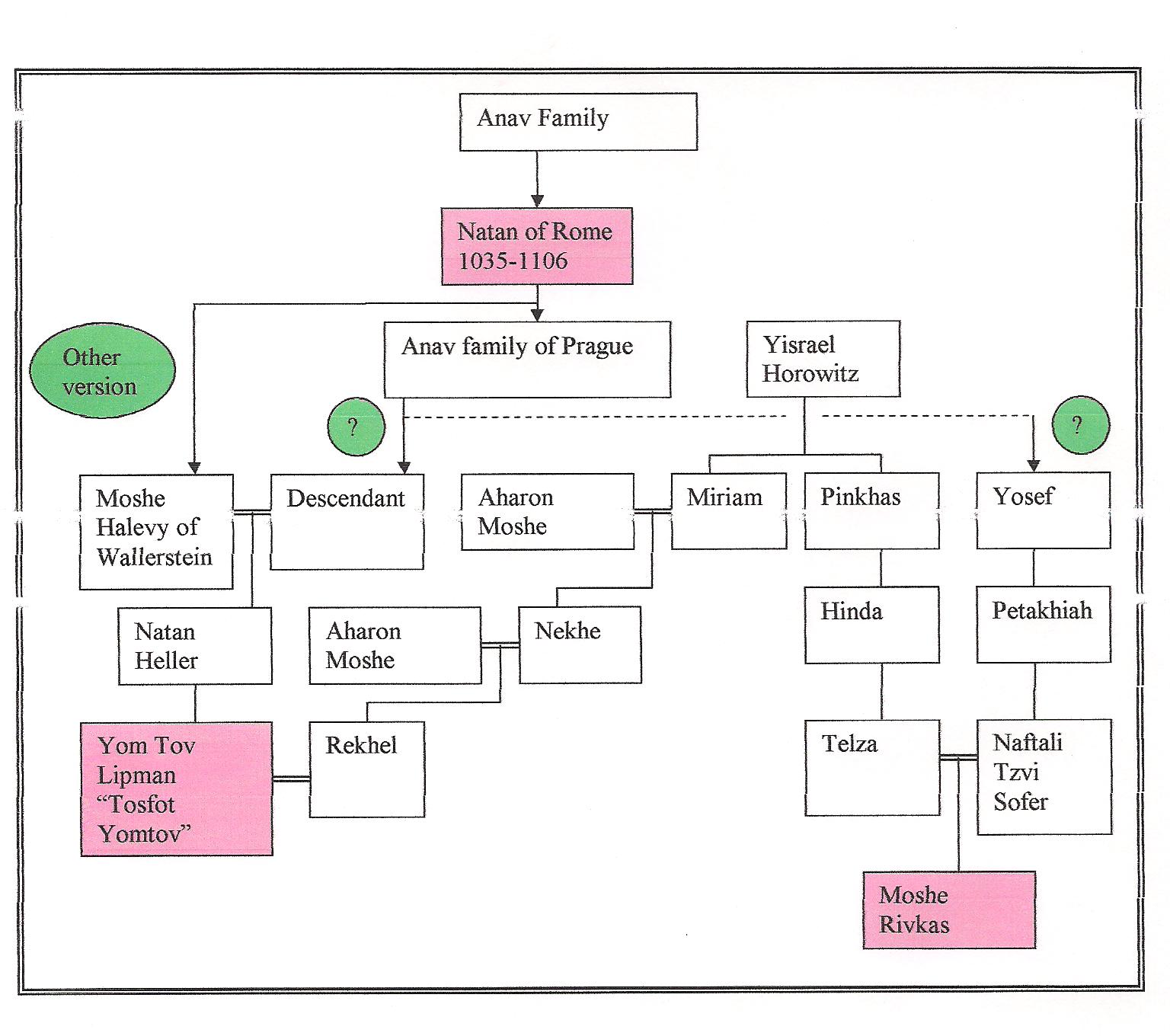
Notes
[1] Freedman, Chaim. Eliyahu’s Branches, the Descendants of the Vilna Gaon and His Family. Avotaynu, Teaneck, New Jersey U.S.A. 1997.
[2] Avotaynu, Spring 1989, Spring 1990, Winter 1994, articles by Neil Rosenstein and Paul Jacobi.
[3] Fishman-Maimon, Yehuda Leib. Sefer Hagra. Jerusalem, 1954.
[4] Ginzberg, Louis. Students Scholars and Saints. New York, 1958.
[5] Dembitzer. Klilat Yofi. Krakow, 1888.
[6] Klausner, Yisrael. Toldot Hakehilah Haivrit Bevilna. Vilna, 1935.
[7] Rivkas, Moshe. Beer Hagolah . Amsterdam 1661-1664.
[8] Rivlin, Eliezer. Sefer Hayakhas Lemishpakhat Rivlin Vehagaon Mivilna. Jerusalem 1935.
[9] Shapira, Yaakov Leib. Mishpakhot Atikot Beyisrael. Tel Aviv 1981.
[10] Kahana, S.Z. Anaf Etz Avot. Krakow 1903.
[11] See reference below.
[12] Avraham son of Eliyahu (the Gaon). Saarat Eliyahu. Grodno 1876.
[13] Heller’s wife was a great grand-daughter of Yisrael Horowitz, who it will be seen later, was an ancestor of Moshe Rivkas.
[14] Eliyahu the Gaon of Vilna. Commentary on Shulkhan Arukh Orakh Khaim. Shklov 1803. Introduction by the Gaon’s sons Yehudah Leib and Avraham.
[15] Freedman, Chaim. Eliyahu’s Branches, the Descendants of the Vilna Gaon and His Family. Avotaynu, Teaneck, New Jersey 1997.
[16] Rivlin, Benyamin. Reb Moshe Rivkas. Jerusalem 1971.
[17] Eizenstadt, Bentzion. Dor rabanav Vesofrav. Vilna 1900.
[18] Edelman, Tzvi Hersh. Gedulat Shaul . London 1845.
[19] Katzenellenbogen, Pinkhas. Yesh Mankhilin. Boskowitz, Moravia 1755; edited by Feld, Yaakov Dov, Jerusalem 1986.
[20] Khefetz family in Prague: Hock, Mishpekhot K”K Prague. Prague 1892.
Koppelman, Lieben. Gal Ed. Prague 1856. Khefetz family in Vilna, see Rivlin.
[21] The exact relationship requires research.
[22] Friedman, Natan Tzvi. Otsar Harabanim. Bnei Brak, Israel 1975.
[23] Muneles, Otto. Ketovot Beveit Ha’almin Hayehudi Ha’atik Beprag. Jerusalem 1988.
Friedberg. B. Toldot Mishpakhat Horowitz. Frankfurt-am-Main, 1911.
[24] Moshe of Pinsk. Shnot Eliyahu. Lemberg 1799, Warsaw 1860.
[25] Rozenkranz, A. Sefer Yukhsin. Warsaw 1885.
[26] Wunder, Meir. Elef Margaliot . Jerusalem 1993
[27] Horowitz-Heller, Yekhiel. Megilat Yukhsin. Tel Aviv 1978.
[1] Freedman, Chaim. Eliyahu’s Branches, the Descendants of the Vilna Gaon and His Family. Avotaynu, Teaneck, New Jersey U.S.A. 1997.
[2] Avotaynu, Spring 1989, Spring 1990, Winter 1994, articles by Neil Rosenstein and Paul Jacobi.
[3] Fishman-Maimon, Yehuda Leib. Sefer Hagra. Jerusalem, 1954.
[4] Ginzberg, Louis. Students Scholars and Saints. New York, 1958.
[5] Dembitzer. Klilat Yofi. Krakow, 1888.
[6] Klausner, Yisrael. Toldot Hakehilah Haivrit Bevilna. Vilna, 1935.
[7] Rivkas, Moshe. Beer Hagolah . Amsterdam 1661-1664.
[8] Rivlin, Eliezer. Sefer Hayakhas Lemishpakhat Rivlin Vehagaon Mivilna. Jerusalem 1935.
[9] Shapira, Yaakov Leib. Mishpakhot Atikot Beyisrael. Tel Aviv 1981.
[10] Kahana, S.Z. Anaf Etz Avot. Krakow 1903.
[11] See reference below.
[12] Avraham son of Eliyahu (the Gaon). Saarat Eliyahu. Grodno 1876.
[13] Heller’s wife was a great grand-daughter of Yisrael Horowitz, who it will be seen later, was an ancestor of Moshe Rivkas.
[14] Eliyahu the Gaon of Vilna. Commentary on Shulkhan Arukh Orakh Khaim. Shklov 1803. Introduction by the Gaon’s sons Yehudah Leib and Avraham.
[15] Freedman, Chaim. Eliyahu’s Branches, the Descendants of the Vilna Gaon and His Family. Avotaynu, Teaneck, New Jersey 1997.
[16] Rivlin, Benyamin. Reb Moshe Rivkas. Jerusalem 1971.
[17] Eizenstadt, Bentzion. Dor rabanav Vesofrav. Vilna 1900.
[18] Edelman, Tzvi Hersh. Gedulat Shaul . London 1845.
[19] Katzenellenbogen, Pinkhas. Yesh Mankhilin. Boskowitz, Moravia 1755; edited by Feld, Yaakov Dov, Jerusalem 1986.
[20] Khefetz family in Prague: Hock, Mishpekhot K”K Prague. Prague 1892.
Koppelman, Lieben. Gal Ed. Prague 1856. Khefetz family in Vilna, see Rivlin.
[21] The exact relationship requires research.
[22] Friedman, Natan Tzvi. Otsar Harabanim. Bnei Brak, Israel 1975.
[23] Muneles, Otto. Ketovot Beveit Ha’almin Hayehudi Ha’atik Beprag. Jerusalem 1988.
Friedberg. B. Toldot Mishpakhat Horowitz. Frankfurt-am-Main, 1911.
[24] Moshe of Pinsk. Shnot Eliyahu. Lemberg 1799, Warsaw 1860.
[25] Rozenkranz, A. Sefer Yukhsin. Warsaw 1885.
[26] Wunder, Meir. Elef Margaliot . Jerusalem 1993
[27] Horowitz-Heller, Yekhiel. Megilat Yukhsin. Tel Aviv 1978.
The Maharal of Prague's Descent from King David
The Maharal of Prague’s Descent from King David
Chaim Freedman, Petah Tikvah, March 2006.
Published in "Avotaynu" Volume XXII Number 1, Spring 2006
Rabbi Yehudah Leib[i] the son of Betzalel (circa 1522-1609), known as the “Maharal of Prague”, was one of the world’s most famous rabbis. Revered during his lifetime and by many until this day, the Maharal wrote many scholastic works. Several families claim descent from him, a fact of special importance to them since the Maharal also is widely believed to descend from King David.
Rabbi Meir Perels of Prague created a genealogy of the Maharal’s family, Megilat Hayukhsin[ii], in 1727 (some say 1717). The book was not published until 1853 and since then genealogists generally have accepted Perels’ claims, many incorporating Perels’ findings into their own works.
An exception to the believers in Perels’ claim was Prague historian Otto Muneles who discovered (in the early 1950s) that Perels’ claim was invalid since it was based on an erroneous copying of the date of death on the tombstone in Prague of the Maharal’s supposed great-great-grandfather Yehudah Leib (Liwai) the Elder. Perels recorded the date in Hebrew as the Hebrew year corresponding to 1439/1440.
Muneles’ examination of that tombstone shows that the date corresponds to 1539. Since the Maharal, also named Yehudah Leib, bore the same name as Yehudah Leib the Elder, and since the Maharal was born about 1522, he could not have borne the same name as a living ancestor. Soon thereafter, critical rabbinic genealogist, Rabbi Shlomo Englard of Bnei Brak, Israel, examined Muneles’ claims and, by studying sources described below, determined that Muneles’ claims were valid.
If the basis for the claim to Davidic descent of the Maharal is the text of the tombstone of Yehudah Leib the Elder (called in Hebrew Hazaken) then this would indicate that the Maharal may not be descended from King David at all. The consequences of such a finding would seem to sever all the descendants of the Maharal from their assumed Davidic descent. Such a circumstance would be particular serious for many famous rabbinic families whose ancestors wrote in many rabbinic works and genealogies of their Davidic descent, based on Perels’ work.
I have studied Muneles’ and Englard’s analyses of the situation and find them valid in negating the basis of Perels’ claim. On the other hand, my study of a number of rabbinic genealogies, written independently of Perels’ book, show that the Maharal indeed was descended from King David, but through a different line from that claimed by Perels. The descendants of the Maharal may breathe a sigh of relief; their illustrious ancestry has been salvaged.
An Alternative Line from the Maharal to King David
Prior to publication of Perels’ work a tradition existed that the Maharal was a descendant of Rabbi Yehudah Hanassi (died 217 C.E.), of the House of Hillel, who was of Davidic descent. These genealogies list the Maharal's father Betzalel and Chaim of Worms, and do not include Yehudah-Leib (Liwai) of Prague. The genealogies also do not trace the ancestry through the much-disputed line back to Hai Gaon and thence to the Exilarchs and King Solomon. Rather they state descent from Yehudah Hanassi, without listing the intervening generations.

Figure 1. Tombstone of Rabbi Yehudah Leib (Liwai) the Elder in the ancient cemetery in Prague.
The year is partially obscured by vegetation so Polakovic excavated the base of the tombstone to reveal the essential line where the date can be seen clearly:

The date on the bottom line is "shin" (the Hebrew year 5300) which corresponds to1539/40, The inscription is identical with that copied by Muneles in his book in 1955[iii].
Some Important Facts:
The Maharal died in 1609 at the age of 97 or 87 [iv]. Thus he was born about 1512 or 1522.
He was born in Posen, not Prague. His father Betzalel and grandfather Chaim lived in Worms as did his uncle Yaakov. Neither his father nor grandfather is buried in Prague.
Someone named Yehudah Leib the Elder died in Prague in 1539. His tombstone includes the inscription "descended from Yishai", which was the name of King David’s father.
Perels wrote a genealogy of the Maharal in 1727, that is, 118 years after the Maharal’s death. The book was published in Zolkiew, Poland, but not until 1853 (and then in Warsaw in 1864).
Perels wrote that Chaim, the grandfather of the Maharal, Khaim was a grandson of the above Yehudah Leib the Elder who was buried in Prague, and that, therefore, the descent of the Maharal's family from King David was proven by the inscription on Yehudah Leib the Elder’s tombstone.

Figure 2. Megilat Yukhsin by Meir Perels.
Translation:
There was one man who was called Reb Chaim Worms. And he lived in the Holy Community of Virmeiza[v]. And the man was Kosher and a famous righteous one. And the head of his line of descent was his father’s father. He was called by his name Reb Yehuda Livai the Elder[vi] and on the stone tablet of his tombstone is engraved this language. Our teacher the Rabbi Reb Yehuda Livai and this is to Yehudah. To Torah and certification. Wise of the secrets. Uprooter of mountains and cedars. Proficient in Shas[vii] of the Talmud. And there was nobody to be found in the entire world in sharpness and proficiency and memory. And he is of the trunk of the pedigreed Geonim[viii] whose lineage is from David the son of Yishai. And the rest of the titles which are written about him I did not want to copy. And he was called to the dwelling above in the year five thousand and two hundred[ix] of the Creation. And to this day the above tombstone is in the Holy Community of Prague in the House of Life[x]. And his grandson Reb Chaim had three very important sons Reb Betzalel and Reb Yaakov and Reb Helman.
The date given by Perels is incorrect. Muneles and Polakovic found that the date of death on the Yehudah Leib’s tombstone was in the month of Kheshvan in the year "shin" (5300) not "resh" (5200) as claimed by Perels. That is 1539 not 1440.
Muneles copied the inscription as he saw it before he published his book in 1955[xi].

Figure 3. Transcription by Muneles of the tombstone in Prague of Rabbi Yehudah Leib the Elder
Translation:
Our Teacher the Rabbi Reb Liva
A lion’s whelp of Yehudah: In Torah and certification: He was engaged in them all his days: Charity he gave to the poor of his nation: And he was of the trunk of the Geonim: His deeds were fitting: Wise of the secrets: He was proficient in the six orders[xii]: He departed at a ripe old age” ….. about him …. Will drop ….. Yishai….Cheshvan Shin[xiii] according to the lower detail[xiv]. May his soul be bound up in the bond of life.
Muneles claims that Perels’ book raises many doubts, because of the date discrepancy with the existing stone and because its location is in an area that did not belong to the cemetery in 1439/40. Further evidence arises from David Gans’ book Tzemakh David (1543) in which Gans writes that he saw the tombstone of Avigdor Kara. Since Kara’s tombstone is located next to that of Yehuda Liva and since Gans took a particular interest in the Maharal of Prague, one might expect Gans to comment on the adjacent tombstone of Yehuda Liva if he believed that Liva was an ancestor of the Maharal.
Shlomo Englard, an authority on critical rabbinic genealogical evaluation, also questioned the authenticity of Perels’ claims[xv]
Translation of Englard’s article:
“In all the genealogies which are in our hands the Maharal of Prague is descended from his grandfather[xvi] Our Teacher the Rabbi Reb Livai the Elder of Prague, who was of the trunk of the Geonim whose lineage was from David the son of Yishai. There are those who added (on their own authority) that his lineage goes back to Reb Hai Gaon the son of Sherira Gaon, whose lineage goes back to the kingdom of the House of David. Great doubt should be cast upon this.”
Englard quotes the claim of Perels, noting that it was not published until 1853.
“In these lines Rabbi Perels connects the lineage of the Maharal of Prague to Yehuda Livai the Elder and upwards in holiness to King David of blessed memory. Thenceforth all the genealogies copied [Perels].”
Englard further states that the tombstone referred to by Perels still stands in the ancient cemetery of Prague, and the inscription is quoted in Gal Ed[xvii] and in Muneles’ book on the inscriptions in the Prague cemetery[xviii], with certain variations from Perels’ transcription. Botyhbooks quote the year “Shin” [1539] and not “resh” [1439/1440] as claimed by Perels, the critical discrepancy. Muneles points out that the section of the cemetery where the tombstone stands was not part of that cemetery in the year 1440. Englard draws the conclusion that the Maharal, whose name was Yehudah Leib (or Liva) was aged either 97 or 87 when he died in 1609, and therefore born well before Yehudah Leib the Elder died. Since they bore the same personal name, and since Ashkenazi Jewish naming practice forbids the naming of a child after a living ancestor, then the Maharal could not have been descended from Yehudah Leib the Elder.
Englard debates Muneles’ claims as to the reason Perels erred in the year 1439, doubting that it was done deliberately in order to connect the Maharal’s family with Prague and with King David. Perels was a noted scholar and official of the community, and he would not have dared to perpetrate such a forgery, since it could be checked at any time by anyone who visited the cemetery. Englard surmises that Perels either erred in his transcription or received a copy from some other person. Englard further propounds that Perels heard of a tradition that the Maharal was descended from someone called Yehudah Leib who lived a considerable time earlier and presumed that this forebear was the so called Yehudah Leib the Elder. A further discrepancy in Perels’ transcription is that the tombstone recorded descent from David the son of Yishai. Examination of the tombstone will see reference to “Geonim”[xix] and then an area of the tombstone which is damaged and mostly illegible, with only the word “Yishai” discernable”. But perhaps the words preceding “Yishai” were discernable in Perels’ time.

Englard continues with his critique of the Maharal claim to Davidic descent by drawing attention to later works that incorrectly claimed that all the generations prior to Yehudah Leib the Elder were known back to Hai Gaon. Prominent among these works is Weinstok’s Mekor Niftakh Lebeit David[xx] [A source opening to the House of David] and Shapira’s “Mishpekhot Atikot Beyisarel [Ancient Families in Israel][xxi]. All modern genealogists have accepted these incorrect claims which Englard suggests may have been fabricated by some unknown writer. The names linking Hai Gaon with Yehudah Liva the Elder first appeared in Kol Beramah (Jerusalem 1911).
In another article [Tsfunot #11) Englard quotes from Beit Aharon (Berlin 1829) the genealogy of Rabbi Mirels of Shwerin which says: “On his mother’s side the Gaon Reb Leib (of Krakow) was a grandson of the Gaon Maharal of Prague who was of the family of Rashi and Rabbi Yokhanan the Sandlar.

Figure 4. Extract from an article by Englard.
This source shows that even prior to the publication of Perels’ genealogy in 1853, traditions existed of the Maharal’s descent from the House of David, not through Yehudah Leib the Elder or Hai Gaon, but through Rashi (1040-1105) and his ancestor Yokhanan the Sandlar (died 140 C.E.). Yokhanan was a descendant of House of Hillel as was Rabbi Yehudah Hanassi, who Beilinsohn and others also claimed was the Maharal’s ancestor.
Proof of the date of death of Yehuda Leib the Elder already appeared in Gal Ed[xxii] by Lieben published in Prague in 1856. A chronological list of tombstones does not include a Liwa or (Yehudah Leib) in the year “resh” (1439/40)

Figure 5. Gal Ed, Lieben, Prague, 1856, chronological list of tombstones.
However there is a “R. Lowe” listed who died in the year “Shin” (1539).
Biographical notes about the Maharal of Prague (#8 on page 2 of Gal Ed) refer to: “Jehuda son of Betzalel son of Chaim”. No mention is made of Chaim’s parentage or ancestry , as he might have been expected to do if he knew any earlier names, such as Yehudah Leib the Elder.


Figure 6. Gal Ed, Lieben, Prague, 1856. Biographical notes about the Maharal of Prague.
The Maharal held the position of Landesrabbiner of all Moravia from 1553. Therefore, even if his date of birth (c.1522) might be claimed to be wrong, such that he might have been born after the alleged death of Yehudah Leib Hazaken in 1539, the Maharal would then have been aged 13, and would have been too young to hold such a position.
Brief details of “Lowe” are given #53 on page 37 of Gal Ed

Figure 7. Gal Ed, Lieben, Prague, 1856. Biographical notes about Rabbi Yehudah Leib (Lowe) the Elder.
No connection is claimed with the Maharal, and that part of Lowe’s tombstone claimed to indicate Davidic descent, is not mentioned. But he Lowe is described as “learned and descended from famous rabbis”.
Perhaps the family of the Maharal had a tradition they were descended from King David, and this tradition existed before Moshe Perels wrote his genealogy of the Maharal in 1727. The family did not know the details of the generations prior to the Maharal's grandfather Chaim of Worms. It is possible that it was known that the Maharal was named after an ancestor called Yehudah Leib. When Perels wrote his genealogy of the Maharal, he sought ancestors in the Prague cemetery and assumed that Yehudah Leib the Elder was an ancestor of the Maharal.
Possibilities for Perel’s error
Perhaps Perels saw the tombstone during a visit to the cemetery, but did not copy the exact details of the inscription. Later he may have sent somebody to copy the tombstone and that person erred in the date. Possibly the lowest line of the tombstone where the date appears was partially covered in mud thus obscuring part of the letter shin (1539), and what remained visible of the letter was misread as resh (1439), thus allowing, according to Perels, the possibility that Yehudah Leib the Elder was an ancestor of Yehudah Leib the Maharal, which could not be so had Perels read the date as shin (1539).
Evidence of a tradition of Davidic descent can be found in several sources that apparently were unaware of Perels’ incorrect claim.
The earliest of these sources dates from 1851:
Figure 8. Megilat Yukhsin , Beilinsohn, Moshe Eliezer, Odessa 1851[xxiii]

Translation:
Yehuda Liva son of Reb Betzalel, called by the scholars Maharal of Prague and his lineage is until the holy Tanna Rabbi Yehudah Hanassi of blessed memory.
This lineage is repeated in a source from 1863


Figure 9. Megilat Yukhsin , Beilinsohn, Moshe Eliezer, Odessa 1863 [xxiv]
Translation:
the authorized Gaon and head of all the children of the Exile, the G-dly man, Marana Yehuda Liva son of Reb Betzalel son of Reb Chaim, known by the scholars, and his lineage is until the holy Tanna Reb Yehuda Hanassi of blessed memory as explained in the book Marot Hatzovot[xxv], and Arkhei Hakinuim[xxvi] – and until King David, peace be unto him.

Figure 10. Zikhron Lemoshe Moshe Rashkes, Odessa 1873.
Translation of last few lines:
Tzvi Saba son of Yosef Yoshke, Av Beit Din of Lublin, grandson of the great eagle, the absolute Gaon, head of the Exile, marana[xxvii] Liva son of Betzalel, of blessed and holy memory, known by the name Maharal from Prague. And his lineage is from the holy Tanna Reb Yehudah Hanassi as explained in the books Arkhei Hakinuim, Marot Tzovot.
Rashkes’ terminology seems almost identical to that used by his relative Beilinsohn in his 1851 and 1863 genealogies. Notable by his absence is the so-called Yehudah-Leib (Livai) the Elder. It seems, therefore that neither Beilinsohn nor Rashkes were aware of Perels’ book published in 1853 and 1864. Yet they were aware, independently, of a tradition of descent of the Maharal from King David through Yehudah Hanassi, the editor of the Mishnah.
In the genealogies he published after 1893, however, Beilinsohn changed his story and introduced Yehuda Leib the Elder as the grandfather of Chaim of Worms. He gives Yehuda Leib’s date of death as the year resh (1439)
For example:

Figure 11. Megilat Yukhsin of the Aleksandrov Family , Beilinsohn, Moshe Eliezer, Odessa 1893
Translation of last few lines:
Yosef Yoshke, Av Beit Din of Lublin, descendant of the great eagle the authoritative Gaon, the G-dly head of all the exile, Marana ve rabana Yehuda Liva son of Betzalel, Av Beit Din of all the kingdom of Moravia and Prague ……..known as the Maharal from Prague of blessed memory, son of the Rabbi Khaim of Vermeisa of blessed memory, grandson of the Gaon, nobleman of the Torah, Marana Yehuda Livai of Vermeisa, of blessed memory, died in Prague in the year Resh, and his lineage goes back to the holy Tanna rabeinu Yehuda Hanassi who is descended from the house of our lord David the King…
Note that although Beilinsohn accepts Perels’ incorrect version, Beilinsohn still maintains that descent from King David was through Yehudah Hanassi and not Hai Gaon, the erroneous (or fraudulent) genealogy given by Weinstok.
Requirement for Further research
Further research that might clarify the descent of the Maharal should include books written by close relatives of the Maharal to ascertain whether they referred to their ancestry from King David. Books researched so far by this author include many of the Maharal’s books as well as two books written by his brother Chaim Igeret Hatiyul (published in Lemberg in 1864) and Sefer Hakhaim. None of these works refer to the ancestry of the authors. Nor does the extensive inscription on the tombstone of the Maharal in the Prague cemetery.
Conclusion
Perels’ error in the date of death of Yehudah Leib the Elder does not necessarily eliminate the possibility that the Maharal descended from King David, in some way other than through the so-called Yehudah Leib the Elder. Many indicators point to a tradition of descent from Rabbi Yehudah Hanassi, of the House of Hillel, who descended from King David’s son Shefatiah, and not through Hai Gaon who was descended from King Solomon. Unfortunately the names of the Maharal’s ancestors between his grandfather Chaim of Worms and Rabbi Yehudah Hanassi are not recorded in any known source.
References
1. Rabbi Shlomo Englard of Bnei Brak, Israel. A descendant of prominent rabbinical families, Rabbi Englard has devoted his scholarly research to the task of verifying traditional lines of descent of the famous rabbinical families. To this purpose he has reanalyzed the sources quoted by the authors of rabbinical genealogies as the basis for the lines of descent presented by them. Englard has checked these claims through independent research of additional sources. Painstaking comparison and analysis of rare texts, rabbinical compositions, recorded tombstone inscriptions have led Englard to conclude that the some of classical “ authorities” erred in confusing the identities of rabbis of the same name; used invalid dates of birth and death, which are incompatible with calculated historical time frames, and presented material which conflicts with facts presented in other verifiable sources.
Englard has published the results of his research in a number of articles in the journal Tsfunot. See the article about by Neil Rosenstein “Englard’s Articles on Questions in Rabbinic Genealogy”, Avotaynu, Volume XII, Number 1, Spring 1996.
2. Beilinsohn, Moshe Eliezer, author of Megilat Yukhsin, Shelomei Emunei Yisrael
a series of booklets published in Odessa from 1851 until the early 1900’s providing very detailed genealogical material for mainly Belarus rabbinical families. Since the author included all the members of a family known to him, this is a valuable source not only for rabbis, but also for their non-rabbinic descendants.
Principle families include Heilprin, Luria, Beilinson, Katz, Maharal of Prague, Raskin, Gunzburg, Mirkin, Rozenberg, Reichenstein, Dubnov, Tumarkin, Vilda, Kisin, Alexandrov, Margolis, Simchovitch, Ettinger, Brauda, Sirkin, Frumkin, Kazarnovsky, Freides, Zeitlin.
3. Muneles, Otto author of Ketovot Mibeit Ha'almin Hayehudi Ha'atic Beprag (Inscriptions in the ancient Jewish cemetery in Prague), Jerusalem 1988.
Muneles, who lived in Prague wrote his book in Czech, Hebrew and German versions. The Czech version was published in 1955. The Hebrew version was smuggled out of Czechoslovakia to Israel in 1966, shortly before Muneles died. But it remained unpublished until 1988.
Notes
[i] Yehudah Leib is one of the many extant variant spellings of his name. Other authors refer to him as Liwai, Liva, Loew, Loeb.
[ii] Megilat Yukhsin, Perels, Meir, written 1727 , or 1717 in Prague, and first published in 1853 in Zolkiev and again by Noakh Chaim Levin in Warsaw in 1864.
[iii] Muneles, Otto, Jerusalem 1988 Ketovot Mibeit Ha'almin Hayehudi Ha'atic Beprag (Inscriptions in the ancient Jewish cemetery in Prague).
[iv] Shem Vesheerit Katz, Krakow, 1895, page 9. Dor Yesharim. Katz, Berdichev, 1898, page 28.
[v] Virmeisa is a variant form of the town Worms in the Rhineland, Germany.
[vi] In Hebrew “Hazaken”.
[vii] Shas - acrostic for the six orders of the Mishnah
[viii] Geonim – Talmudic sages.
[ix] Resh = 1439/1440, depending on the month. From Muneles transcript of the tombstone and its photograph, it is known that the month was Cheshvan. Therefore the year “resh” corresponded to 1439.
[x] Cemetery.
[xi] Muneles, Otto, Jerusalem 1988 Ketovot Mibeit Ha'almin Hayehudi Ha'atic Beprag (Inscriptions in the ancient Jewish cemetery in Prague).
[xii] Six orders of the Mishnah..
[xiii] Five thousand two hundred = 1539.
[xiv] Abbreviation commonly found on tombstones whereby the letter “Hei” , five thousand is left of the date.
[xv] Tsfunot #12" reprinted in England's collection of his articles, Bnei Brak 2004.
[xvi] General term for `ancestor’ and not necessarily `grandfather’.
[xvii] Gal Ed, Lieben, Koppelmann, Prague 1856.
[xviii] Muneles, Otto, Jerusalem 1988 Ketovot Mibeit Ha'almin Hayehudi Ha'atic Beprag (Inscriptions in the ancient Jewish cemetery in Prague).
[xix] Geonim – Talmudic sages.
[xx] Makor Niftakh Lebeit David. Weinstok, Moshe Yair. Israel 1969.
[xxi] Mishpakhot Atikot Beyisreal [Ancient Families in Israel]. Shapira, Yaakov Leib, Israel 1981.
[xxii] Gal Ed Lieben, Koppelmann, Prague 1856
[xxiii] Manuscript provided by Rabbi Shlomo Englard.
[xxiv] Printed version of the same genealogy, held by the great-grandfather of the late Rabbi Shmuel Gorr.
[xxv] Marot Hatzovot, Moshe Zeev Wolf of Tiktin and Bialystok, Grodno 1810.
[xxvi] Arkhei Hakinuim, Yekhiel Heilprin, author of Seder Hadorot. 1769.
[xxvii] Marana – a term of honor.
Chaim Freedman, Petah Tikvah, March 2006.
Published in "Avotaynu" Volume XXII Number 1, Spring 2006
Rabbi Yehudah Leib[i] the son of Betzalel (circa 1522-1609), known as the “Maharal of Prague”, was one of the world’s most famous rabbis. Revered during his lifetime and by many until this day, the Maharal wrote many scholastic works. Several families claim descent from him, a fact of special importance to them since the Maharal also is widely believed to descend from King David.
Rabbi Meir Perels of Prague created a genealogy of the Maharal’s family, Megilat Hayukhsin[ii], in 1727 (some say 1717). The book was not published until 1853 and since then genealogists generally have accepted Perels’ claims, many incorporating Perels’ findings into their own works.
An exception to the believers in Perels’ claim was Prague historian Otto Muneles who discovered (in the early 1950s) that Perels’ claim was invalid since it was based on an erroneous copying of the date of death on the tombstone in Prague of the Maharal’s supposed great-great-grandfather Yehudah Leib (Liwai) the Elder. Perels recorded the date in Hebrew as the Hebrew year corresponding to 1439/1440.
Muneles’ examination of that tombstone shows that the date corresponds to 1539. Since the Maharal, also named Yehudah Leib, bore the same name as Yehudah Leib the Elder, and since the Maharal was born about 1522, he could not have borne the same name as a living ancestor. Soon thereafter, critical rabbinic genealogist, Rabbi Shlomo Englard of Bnei Brak, Israel, examined Muneles’ claims and, by studying sources described below, determined that Muneles’ claims were valid.
If the basis for the claim to Davidic descent of the Maharal is the text of the tombstone of Yehudah Leib the Elder (called in Hebrew Hazaken) then this would indicate that the Maharal may not be descended from King David at all. The consequences of such a finding would seem to sever all the descendants of the Maharal from their assumed Davidic descent. Such a circumstance would be particular serious for many famous rabbinic families whose ancestors wrote in many rabbinic works and genealogies of their Davidic descent, based on Perels’ work.
I have studied Muneles’ and Englard’s analyses of the situation and find them valid in negating the basis of Perels’ claim. On the other hand, my study of a number of rabbinic genealogies, written independently of Perels’ book, show that the Maharal indeed was descended from King David, but through a different line from that claimed by Perels. The descendants of the Maharal may breathe a sigh of relief; their illustrious ancestry has been salvaged.
An Alternative Line from the Maharal to King David
Prior to publication of Perels’ work a tradition existed that the Maharal was a descendant of Rabbi Yehudah Hanassi (died 217 C.E.), of the House of Hillel, who was of Davidic descent. These genealogies list the Maharal's father Betzalel and Chaim of Worms, and do not include Yehudah-Leib (Liwai) of Prague. The genealogies also do not trace the ancestry through the much-disputed line back to Hai Gaon and thence to the Exilarchs and King Solomon. Rather they state descent from Yehudah Hanassi, without listing the intervening generations.
The problem of the ancestry of the Maharal of Prague was debated on Jewishgen in 2002 when Daniel Polakovic, of the Jewish Museum in Prague posted the following:
“There was a great discussion on this forum about the reliability of Perles's book "Megillat Yuhasin" on the roots of the MaHaRaL of Prague. One of the problematic points was a gravestone of "his relative" Yehuda Loeb the Elder. Since I work in the Jewish museum of Prague, I've had access to the archives of the Prague Hevra Kadisha from the 17th-20th century. Among these documents are the transcriptions of the gravestones of the old Jewish Cemetery of Prague. I've done this repeatedly and so far about 12,000 gravestones have been copied.Naturally, the gravestone of Rabbi Yehuda Loeb "the Elder" mentioned by Perles was found, and it still stands up to present time. The inscription is almost identical with Perles's version except for the dating (not 1440 but 1540) and the last line of the gravestone which was romantically improved for this purpose (a passage about the descendant of Davidic royal dynasty). I assume that these lines in Perles's book aren't his alone, but only the addition from the beginning of the 19th century (probably of Polish origin), because this book was not edited for the first time until 1864.
The photo of the above mentioned gravestone is available for inspection at http://www.geocities.com/danpolak/liva2.jpg It originated from the 1950s, at that time a full setof pictures of gravestones from this cemetery were taken”
“There was a great discussion on this forum about the reliability of Perles's book "Megillat Yuhasin" on the roots of the MaHaRaL of Prague. One of the problematic points was a gravestone of "his relative" Yehuda Loeb the Elder. Since I work in the Jewish museum of Prague, I've had access to the archives of the Prague Hevra Kadisha from the 17th-20th century. Among these documents are the transcriptions of the gravestones of the old Jewish Cemetery of Prague. I've done this repeatedly and so far about 12,000 gravestones have been copied.Naturally, the gravestone of Rabbi Yehuda Loeb "the Elder" mentioned by Perles was found, and it still stands up to present time. The inscription is almost identical with Perles's version except for the dating (not 1440 but 1540) and the last line of the gravestone which was romantically improved for this purpose (a passage about the descendant of Davidic royal dynasty). I assume that these lines in Perles's book aren't his alone, but only the addition from the beginning of the 19th century (probably of Polish origin), because this book was not edited for the first time until 1864.
The photo of the above mentioned gravestone is available for inspection at http://www.geocities.com/danpolak/liva2.jpg It originated from the 1950s, at that time a full setof pictures of gravestones from this cemetery were taken”


Figure 1. Tombstone of Rabbi Yehudah Leib (Liwai) the Elder in the ancient cemetery in Prague.
The year is partially obscured by vegetation so Polakovic excavated the base of the tombstone to reveal the essential line where the date can be seen clearly:

The date on the bottom line is "shin" (the Hebrew year 5300) which corresponds to1539/40, The inscription is identical with that copied by Muneles in his book in 1955[iii].
Some Important Facts:
The Maharal died in 1609 at the age of 97 or 87 [iv]. Thus he was born about 1512 or 1522.
He was born in Posen, not Prague. His father Betzalel and grandfather Chaim lived in Worms as did his uncle Yaakov. Neither his father nor grandfather is buried in Prague.
Someone named Yehudah Leib the Elder died in Prague in 1539. His tombstone includes the inscription "descended from Yishai", which was the name of King David’s father.
Perels wrote a genealogy of the Maharal in 1727, that is, 118 years after the Maharal’s death. The book was published in Zolkiew, Poland, but not until 1853 (and then in Warsaw in 1864).
Perels wrote that Chaim, the grandfather of the Maharal, Khaim was a grandson of the above Yehudah Leib the Elder who was buried in Prague, and that, therefore, the descent of the Maharal's family from King David was proven by the inscription on Yehudah Leib the Elder’s tombstone.

Figure 2. Megilat Yukhsin by Meir Perels.
Translation:
There was one man who was called Reb Chaim Worms. And he lived in the Holy Community of Virmeiza[v]. And the man was Kosher and a famous righteous one. And the head of his line of descent was his father’s father. He was called by his name Reb Yehuda Livai the Elder[vi] and on the stone tablet of his tombstone is engraved this language. Our teacher the Rabbi Reb Yehuda Livai and this is to Yehudah. To Torah and certification. Wise of the secrets. Uprooter of mountains and cedars. Proficient in Shas[vii] of the Talmud. And there was nobody to be found in the entire world in sharpness and proficiency and memory. And he is of the trunk of the pedigreed Geonim[viii] whose lineage is from David the son of Yishai. And the rest of the titles which are written about him I did not want to copy. And he was called to the dwelling above in the year five thousand and two hundred[ix] of the Creation. And to this day the above tombstone is in the Holy Community of Prague in the House of Life[x]. And his grandson Reb Chaim had three very important sons Reb Betzalel and Reb Yaakov and Reb Helman.
The date given by Perels is incorrect. Muneles and Polakovic found that the date of death on the Yehudah Leib’s tombstone was in the month of Kheshvan in the year "shin" (5300) not "resh" (5200) as claimed by Perels. That is 1539 not 1440.
Muneles copied the inscription as he saw it before he published his book in 1955[xi].

Figure 3. Transcription by Muneles of the tombstone in Prague of Rabbi Yehudah Leib the Elder
Translation:
Our Teacher the Rabbi Reb Liva
A lion’s whelp of Yehudah: In Torah and certification: He was engaged in them all his days: Charity he gave to the poor of his nation: And he was of the trunk of the Geonim: His deeds were fitting: Wise of the secrets: He was proficient in the six orders[xii]: He departed at a ripe old age” ….. about him …. Will drop ….. Yishai….Cheshvan Shin[xiii] according to the lower detail[xiv]. May his soul be bound up in the bond of life.
Muneles claims that Perels’ book raises many doubts, because of the date discrepancy with the existing stone and because its location is in an area that did not belong to the cemetery in 1439/40. Further evidence arises from David Gans’ book Tzemakh David (1543) in which Gans writes that he saw the tombstone of Avigdor Kara. Since Kara’s tombstone is located next to that of Yehuda Liva and since Gans took a particular interest in the Maharal of Prague, one might expect Gans to comment on the adjacent tombstone of Yehuda Liva if he believed that Liva was an ancestor of the Maharal.
Shlomo Englard, an authority on critical rabbinic genealogical evaluation, also questioned the authenticity of Perels’ claims[xv]
Translation of Englard’s article:
“In all the genealogies which are in our hands the Maharal of Prague is descended from his grandfather[xvi] Our Teacher the Rabbi Reb Livai the Elder of Prague, who was of the trunk of the Geonim whose lineage was from David the son of Yishai. There are those who added (on their own authority) that his lineage goes back to Reb Hai Gaon the son of Sherira Gaon, whose lineage goes back to the kingdom of the House of David. Great doubt should be cast upon this.”
Englard quotes the claim of Perels, noting that it was not published until 1853.
“In these lines Rabbi Perels connects the lineage of the Maharal of Prague to Yehuda Livai the Elder and upwards in holiness to King David of blessed memory. Thenceforth all the genealogies copied [Perels].”
Englard further states that the tombstone referred to by Perels still stands in the ancient cemetery of Prague, and the inscription is quoted in Gal Ed[xvii] and in Muneles’ book on the inscriptions in the Prague cemetery[xviii], with certain variations from Perels’ transcription. Botyhbooks quote the year “Shin” [1539] and not “resh” [1439/1440] as claimed by Perels, the critical discrepancy. Muneles points out that the section of the cemetery where the tombstone stands was not part of that cemetery in the year 1440. Englard draws the conclusion that the Maharal, whose name was Yehudah Leib (or Liva) was aged either 97 or 87 when he died in 1609, and therefore born well before Yehudah Leib the Elder died. Since they bore the same personal name, and since Ashkenazi Jewish naming practice forbids the naming of a child after a living ancestor, then the Maharal could not have been descended from Yehudah Leib the Elder.
Englard debates Muneles’ claims as to the reason Perels erred in the year 1439, doubting that it was done deliberately in order to connect the Maharal’s family with Prague and with King David. Perels was a noted scholar and official of the community, and he would not have dared to perpetrate such a forgery, since it could be checked at any time by anyone who visited the cemetery. Englard surmises that Perels either erred in his transcription or received a copy from some other person. Englard further propounds that Perels heard of a tradition that the Maharal was descended from someone called Yehudah Leib who lived a considerable time earlier and presumed that this forebear was the so called Yehudah Leib the Elder. A further discrepancy in Perels’ transcription is that the tombstone recorded descent from David the son of Yishai. Examination of the tombstone will see reference to “Geonim”[xix] and then an area of the tombstone which is damaged and mostly illegible, with only the word “Yishai” discernable”. But perhaps the words preceding “Yishai” were discernable in Perels’ time.
However close examination of the photograph after Polakovoc's excavation shows that the word is not "Yishai" at all, put the end of the word "Khamishi", the Hebrew for the fifth day, namely Thursday. This is followed by the date 25th of Kheshvan.

Englard continues with his critique of the Maharal claim to Davidic descent by drawing attention to later works that incorrectly claimed that all the generations prior to Yehudah Leib the Elder were known back to Hai Gaon. Prominent among these works is Weinstok’s Mekor Niftakh Lebeit David[xx] [A source opening to the House of David] and Shapira’s “Mishpekhot Atikot Beyisarel [Ancient Families in Israel][xxi]. All modern genealogists have accepted these incorrect claims which Englard suggests may have been fabricated by some unknown writer. The names linking Hai Gaon with Yehudah Liva the Elder first appeared in Kol Beramah (Jerusalem 1911).
In another article [Tsfunot #11) Englard quotes from Beit Aharon (Berlin 1829) the genealogy of Rabbi Mirels of Shwerin which says: “On his mother’s side the Gaon Reb Leib (of Krakow) was a grandson of the Gaon Maharal of Prague who was of the family of Rashi and Rabbi Yokhanan the Sandlar.

Figure 4. Extract from an article by Englard.
This source shows that even prior to the publication of Perels’ genealogy in 1853, traditions existed of the Maharal’s descent from the House of David, not through Yehudah Leib the Elder or Hai Gaon, but through Rashi (1040-1105) and his ancestor Yokhanan the Sandlar (died 140 C.E.). Yokhanan was a descendant of House of Hillel as was Rabbi Yehudah Hanassi, who Beilinsohn and others also claimed was the Maharal’s ancestor.
Proof of the date of death of Yehuda Leib the Elder already appeared in Gal Ed[xxii] by Lieben published in Prague in 1856. A chronological list of tombstones does not include a Liwa or (Yehudah Leib) in the year “resh” (1439/40)

Figure 5. Gal Ed, Lieben, Prague, 1856, chronological list of tombstones.
However there is a “R. Lowe” listed who died in the year “Shin” (1539).
Biographical notes about the Maharal of Prague (#8 on page 2 of Gal Ed) refer to: “Jehuda son of Betzalel son of Chaim”. No mention is made of Chaim’s parentage or ancestry , as he might have been expected to do if he knew any earlier names, such as Yehudah Leib the Elder.


Figure 6. Gal Ed, Lieben, Prague, 1856. Biographical notes about the Maharal of Prague.
The Maharal held the position of Landesrabbiner of all Moravia from 1553. Therefore, even if his date of birth (c.1522) might be claimed to be wrong, such that he might have been born after the alleged death of Yehudah Leib Hazaken in 1539, the Maharal would then have been aged 13, and would have been too young to hold such a position.
Brief details of “Lowe” are given #53 on page 37 of Gal Ed

Figure 7. Gal Ed, Lieben, Prague, 1856. Biographical notes about Rabbi Yehudah Leib (Lowe) the Elder.
No connection is claimed with the Maharal, and that part of Lowe’s tombstone claimed to indicate Davidic descent, is not mentioned. But he Lowe is described as “learned and descended from famous rabbis”.
Perhaps the family of the Maharal had a tradition they were descended from King David, and this tradition existed before Moshe Perels wrote his genealogy of the Maharal in 1727. The family did not know the details of the generations prior to the Maharal's grandfather Chaim of Worms. It is possible that it was known that the Maharal was named after an ancestor called Yehudah Leib. When Perels wrote his genealogy of the Maharal, he sought ancestors in the Prague cemetery and assumed that Yehudah Leib the Elder was an ancestor of the Maharal.
Possibilities for Perel’s error
Perhaps Perels saw the tombstone during a visit to the cemetery, but did not copy the exact details of the inscription. Later he may have sent somebody to copy the tombstone and that person erred in the date. Possibly the lowest line of the tombstone where the date appears was partially covered in mud thus obscuring part of the letter shin (1539), and what remained visible of the letter was misread as resh (1439), thus allowing, according to Perels, the possibility that Yehudah Leib the Elder was an ancestor of Yehudah Leib the Maharal, which could not be so had Perels read the date as shin (1539).
Evidence of a tradition of Davidic descent can be found in several sources that apparently were unaware of Perels’ incorrect claim.
The earliest of these sources dates from 1851:
Figure 8. Megilat Yukhsin , Beilinsohn, Moshe Eliezer, Odessa 1851[xxiii]

Translation:
Yehuda Liva son of Reb Betzalel, called by the scholars Maharal of Prague and his lineage is until the holy Tanna Rabbi Yehudah Hanassi of blessed memory.
This lineage is repeated in a source from 1863


Figure 9. Megilat Yukhsin , Beilinsohn, Moshe Eliezer, Odessa 1863 [xxiv]
Translation:
the authorized Gaon and head of all the children of the Exile, the G-dly man, Marana Yehuda Liva son of Reb Betzalel son of Reb Chaim, known by the scholars, and his lineage is until the holy Tanna Reb Yehuda Hanassi of blessed memory as explained in the book Marot Hatzovot[xxv], and Arkhei Hakinuim[xxvi] – and until King David, peace be unto him.

Figure 10. Zikhron Lemoshe Moshe Rashkes, Odessa 1873.
Translation of last few lines:
Tzvi Saba son of Yosef Yoshke, Av Beit Din of Lublin, grandson of the great eagle, the absolute Gaon, head of the Exile, marana[xxvii] Liva son of Betzalel, of blessed and holy memory, known by the name Maharal from Prague. And his lineage is from the holy Tanna Reb Yehudah Hanassi as explained in the books Arkhei Hakinuim, Marot Tzovot.
Rashkes’ terminology seems almost identical to that used by his relative Beilinsohn in his 1851 and 1863 genealogies. Notable by his absence is the so-called Yehudah-Leib (Livai) the Elder. It seems, therefore that neither Beilinsohn nor Rashkes were aware of Perels’ book published in 1853 and 1864. Yet they were aware, independently, of a tradition of descent of the Maharal from King David through Yehudah Hanassi, the editor of the Mishnah.
In the genealogies he published after 1893, however, Beilinsohn changed his story and introduced Yehuda Leib the Elder as the grandfather of Chaim of Worms. He gives Yehuda Leib’s date of death as the year resh (1439)
For example:

Figure 11. Megilat Yukhsin of the Aleksandrov Family , Beilinsohn, Moshe Eliezer, Odessa 1893
Translation of last few lines:
Yosef Yoshke, Av Beit Din of Lublin, descendant of the great eagle the authoritative Gaon, the G-dly head of all the exile, Marana ve rabana Yehuda Liva son of Betzalel, Av Beit Din of all the kingdom of Moravia and Prague ……..known as the Maharal from Prague of blessed memory, son of the Rabbi Khaim of Vermeisa of blessed memory, grandson of the Gaon, nobleman of the Torah, Marana Yehuda Livai of Vermeisa, of blessed memory, died in Prague in the year Resh, and his lineage goes back to the holy Tanna rabeinu Yehuda Hanassi who is descended from the house of our lord David the King…
Note that although Beilinsohn accepts Perels’ incorrect version, Beilinsohn still maintains that descent from King David was through Yehudah Hanassi and not Hai Gaon, the erroneous (or fraudulent) genealogy given by Weinstok.
Requirement for Further research
Further research that might clarify the descent of the Maharal should include books written by close relatives of the Maharal to ascertain whether they referred to their ancestry from King David. Books researched so far by this author include many of the Maharal’s books as well as two books written by his brother Chaim Igeret Hatiyul (published in Lemberg in 1864) and Sefer Hakhaim. None of these works refer to the ancestry of the authors. Nor does the extensive inscription on the tombstone of the Maharal in the Prague cemetery.
Conclusion
Perels’ error in the date of death of Yehudah Leib the Elder does not necessarily eliminate the possibility that the Maharal descended from King David, in some way other than through the so-called Yehudah Leib the Elder. Many indicators point to a tradition of descent from Rabbi Yehudah Hanassi, of the House of Hillel, who descended from King David’s son Shefatiah, and not through Hai Gaon who was descended from King Solomon. Unfortunately the names of the Maharal’s ancestors between his grandfather Chaim of Worms and Rabbi Yehudah Hanassi are not recorded in any known source.
References
1. Rabbi Shlomo Englard of Bnei Brak, Israel. A descendant of prominent rabbinical families, Rabbi Englard has devoted his scholarly research to the task of verifying traditional lines of descent of the famous rabbinical families. To this purpose he has reanalyzed the sources quoted by the authors of rabbinical genealogies as the basis for the lines of descent presented by them. Englard has checked these claims through independent research of additional sources. Painstaking comparison and analysis of rare texts, rabbinical compositions, recorded tombstone inscriptions have led Englard to conclude that the some of classical “ authorities” erred in confusing the identities of rabbis of the same name; used invalid dates of birth and death, which are incompatible with calculated historical time frames, and presented material which conflicts with facts presented in other verifiable sources.
Englard has published the results of his research in a number of articles in the journal Tsfunot. See the article about by Neil Rosenstein “Englard’s Articles on Questions in Rabbinic Genealogy”, Avotaynu, Volume XII, Number 1, Spring 1996.
2. Beilinsohn, Moshe Eliezer, author of Megilat Yukhsin, Shelomei Emunei Yisrael
a series of booklets published in Odessa from 1851 until the early 1900’s providing very detailed genealogical material for mainly Belarus rabbinical families. Since the author included all the members of a family known to him, this is a valuable source not only for rabbis, but also for their non-rabbinic descendants.
Principle families include Heilprin, Luria, Beilinson, Katz, Maharal of Prague, Raskin, Gunzburg, Mirkin, Rozenberg, Reichenstein, Dubnov, Tumarkin, Vilda, Kisin, Alexandrov, Margolis, Simchovitch, Ettinger, Brauda, Sirkin, Frumkin, Kazarnovsky, Freides, Zeitlin.
3. Muneles, Otto author of Ketovot Mibeit Ha'almin Hayehudi Ha'atic Beprag (Inscriptions in the ancient Jewish cemetery in Prague), Jerusalem 1988.
Muneles, who lived in Prague wrote his book in Czech, Hebrew and German versions. The Czech version was published in 1955. The Hebrew version was smuggled out of Czechoslovakia to Israel in 1966, shortly before Muneles died. But it remained unpublished until 1988.
Notes
[i] Yehudah Leib is one of the many extant variant spellings of his name. Other authors refer to him as Liwai, Liva, Loew, Loeb.
[ii] Megilat Yukhsin, Perels, Meir, written 1727 , or 1717 in Prague, and first published in 1853 in Zolkiev and again by Noakh Chaim Levin in Warsaw in 1864.
[iii] Muneles, Otto, Jerusalem 1988 Ketovot Mibeit Ha'almin Hayehudi Ha'atic Beprag (Inscriptions in the ancient Jewish cemetery in Prague).
[iv] Shem Vesheerit Katz, Krakow, 1895, page 9. Dor Yesharim. Katz, Berdichev, 1898, page 28.
[v] Virmeisa is a variant form of the town Worms in the Rhineland, Germany.
[vi] In Hebrew “Hazaken”.
[vii] Shas - acrostic for the six orders of the Mishnah
[viii] Geonim – Talmudic sages.
[ix] Resh = 1439/1440, depending on the month. From Muneles transcript of the tombstone and its photograph, it is known that the month was Cheshvan. Therefore the year “resh” corresponded to 1439.
[x] Cemetery.
[xi] Muneles, Otto, Jerusalem 1988 Ketovot Mibeit Ha'almin Hayehudi Ha'atic Beprag (Inscriptions in the ancient Jewish cemetery in Prague).
[xii] Six orders of the Mishnah..
[xiii] Five thousand two hundred = 1539.
[xiv] Abbreviation commonly found on tombstones whereby the letter “Hei” , five thousand is left of the date.
[xv] Tsfunot #12" reprinted in England's collection of his articles, Bnei Brak 2004.
[xvi] General term for `ancestor’ and not necessarily `grandfather’.
[xvii] Gal Ed, Lieben, Koppelmann, Prague 1856.
[xviii] Muneles, Otto, Jerusalem 1988 Ketovot Mibeit Ha'almin Hayehudi Ha'atic Beprag (Inscriptions in the ancient Jewish cemetery in Prague).
[xix] Geonim – Talmudic sages.
[xx] Makor Niftakh Lebeit David. Weinstok, Moshe Yair. Israel 1969.
[xxi] Mishpakhot Atikot Beyisreal [Ancient Families in Israel]. Shapira, Yaakov Leib, Israel 1981.
[xxii] Gal Ed Lieben, Koppelmann, Prague 1856
[xxiii] Manuscript provided by Rabbi Shlomo Englard.
[xxiv] Printed version of the same genealogy, held by the great-grandfather of the late Rabbi Shmuel Gorr.
[xxv] Marot Hatzovot, Moshe Zeev Wolf of Tiktin and Bialystok, Grodno 1810.
[xxvi] Arkhei Hakinuim, Yekhiel Heilprin, author of Seder Hadorot. 1769.
[xxvii] Marana – a term of honor.
Subscribe to:
Posts (Atom)